

2026 Natsu banzuke prediction
Predicting the 2026 Natsu basho banzuke ahead of Grand Sumo's May tournament.
Hello everyone. I hope you’re having a lovely weekend.
Below is my prediction for the next banzuke we have coming out. The one which sets the rankings for the 2026 natsu basho (summer tournament) in May. I’m presenting this one a little differently than with previous predictions. I’m going to try and show more of my methodology when it comes to putting the banzuke together — in case that’s of interest.
Another point of interest, before I continue. You might notice that I’ve changed my name on the byline here. Henceforth, I will be using the name ‘Tim Edwards’ for all my sports writing.
Prior to now I’ve been using my legal name. But I’m about 20 days away from graduating and then being a licensed social service worker. Due to the new career I am embarking on, it makes a lot of sense to put up some firewalls between me the licensed professional and me the blogger. In social work we are bound by a code of ethics that mentions things like conflicts of interest, dual relationships and inappropriate contact. So it’s smart for me to make sure that potential service users can’t look me up and initiate contact outside of our service relationship.
If you notice my old name pop up anywhere related to this, could you do me a favour and let me know?
Ok, onto the fun stuff.
Our bonus gif today is where the magic happens.
Before I get into my prediction, here’s a brief overview of how the banzuke is typically drawn up:
The general rule is that wrestlers move up and down based on their net wins or losses from the past basho. That means that a wrestler who went 8-7 has a net score of +1. That then means they are probably going to move up one space. However, we can’t assume that’s the case for everyone. Context matters. And, also, sometimes you just have to stick guys somewhere that more or less makes sense.
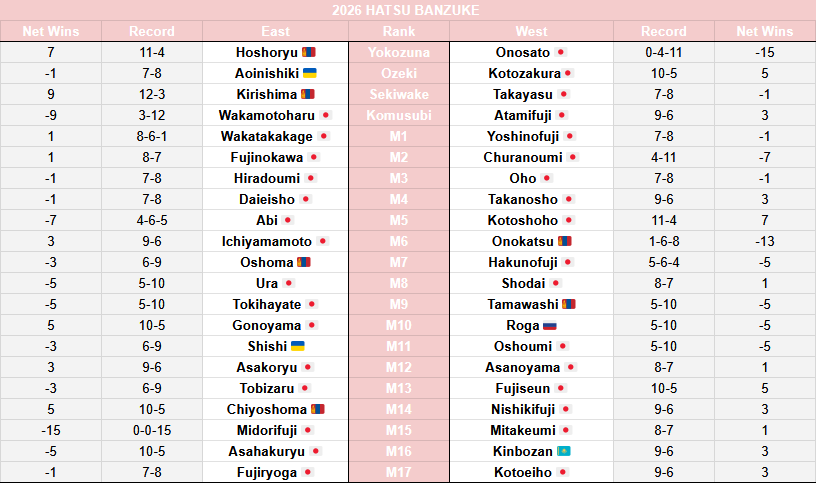
Here’s the real March banzuke, along with the records each wrestler earned at that tournament. I’ve also added columns here for net wins.
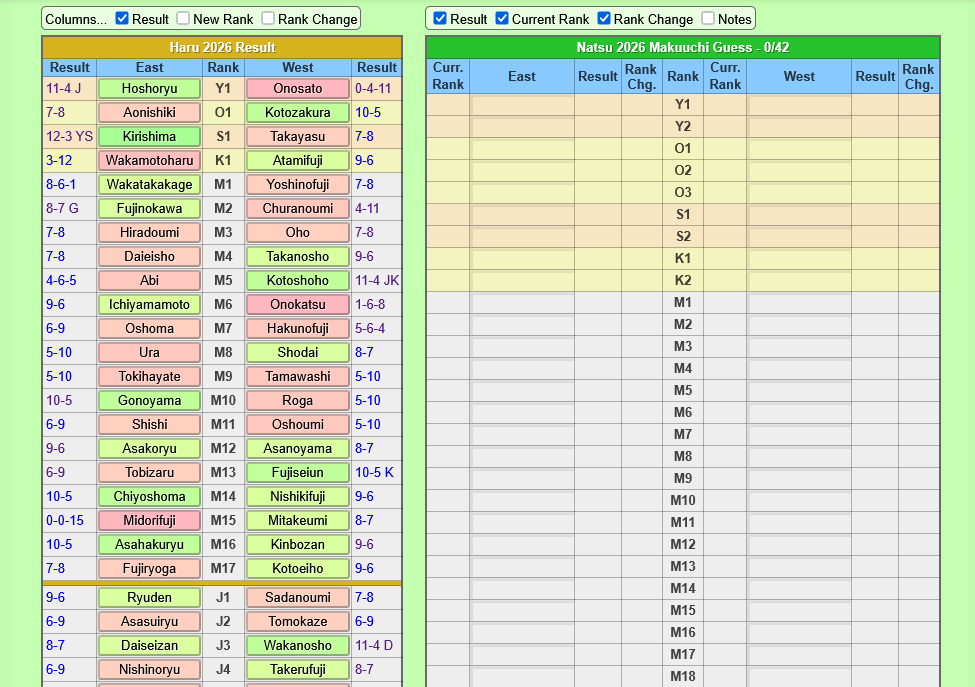
I’m using the Guess The Banzuke helper page (found here) to make my banzuke, while simultaenously writting this post. I want to show you, step by step, how I’m constructing my banzuke.
Here’s the blank page I am greeted by, chocked full with a dizzying array of possibilities.
Let’s get into it.
Step 1: Yokozuna and Ōzeki
Easy peasy.
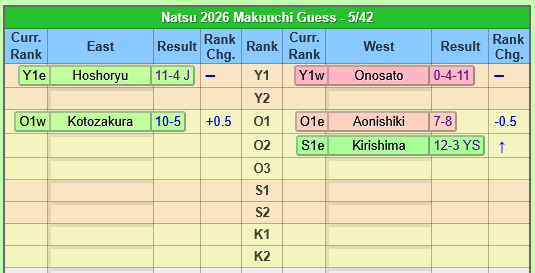
Hōshōryū and Ōnosato stay put, thanks to Hōshōryū getting a better record than Ōnosato in March. This will mark his third straight tournament at the very top of the rankings.
Kotozakura and Aonishiki switch places, since Kotozakura did better than Aonishiki. And Kirishima is promoted from sekiwake to ōzeki thanks to his 34 wins across three tournaments and his yushō in March. Kirishima’s new rank is ōzeki 2 west. When a new line on the banzuke is opened up, within these special ranks, the wrestler goes to the west side of the sheet.
Step 2: The san’yaku
This is kind of straight forward, too.
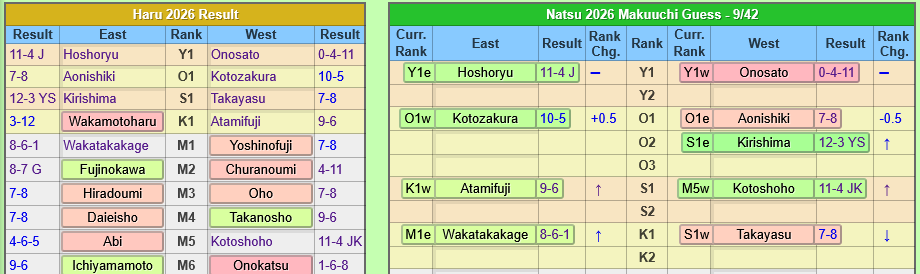
First off, Atamifuji obviously goes from komusubi 1 west to sekiwake 1 east (the spot Kirishima vacated). Takayasu has to lose his sekiwake rank for his losing record, so the S1w spot is open.
I’m putting Kotoshōhō there. That’s a six rank promotion on seven net wins. So that makes sense. And I think Kotoshoho gets to skip over being maegashira 1 and/or komusubi due to how close he was to getting the cup in March.
Wakatakakage goes up one rank and Takayasu goes down one rank to complete this section.
Step 3: The jōi
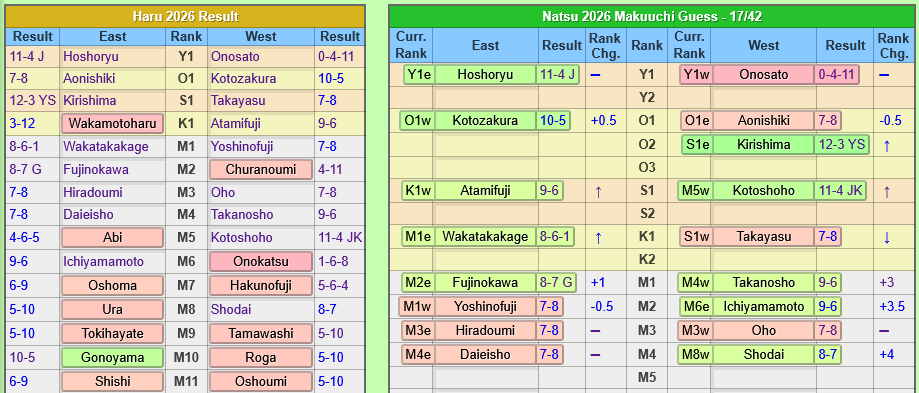
The first part of this is easy. Fujinokawa goes up one spot to M1e and Takanoshō goes up three spots to M1w. Now I have to be very lenient with our preexisting jōi, since there are so few wrestlers just below them with winning records.
Because of that lack of candidates to replace/leap-frog them, Yoshinofuji goes down just half a rank and Hiradoumi, Ōhō and Daieishō all get to stay put despite their 7-8 records. That leaves one spot open for Ichiyamamoto. That promotion is obvious, given his net wins. The last spot is going to Shōdai, since he’s the only person with a winning record anywhere close to this neighbourhood.
Step 4: Let’s move up the winners and losers
Here’s what it looks like when we move all the winners up based on net wins. As you can see, we’ve got traffic jams at M9e, M11w and M14w.
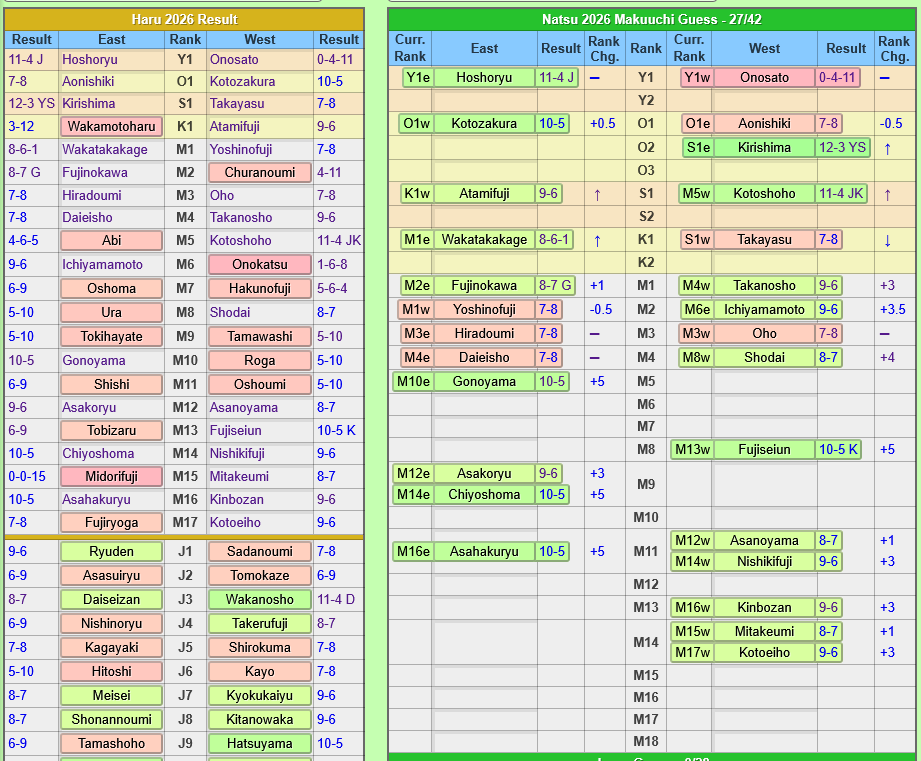
This is what it looks like when I move the losers down based purely on their net losses. Lots more traffic jams and some empty spots (yay).
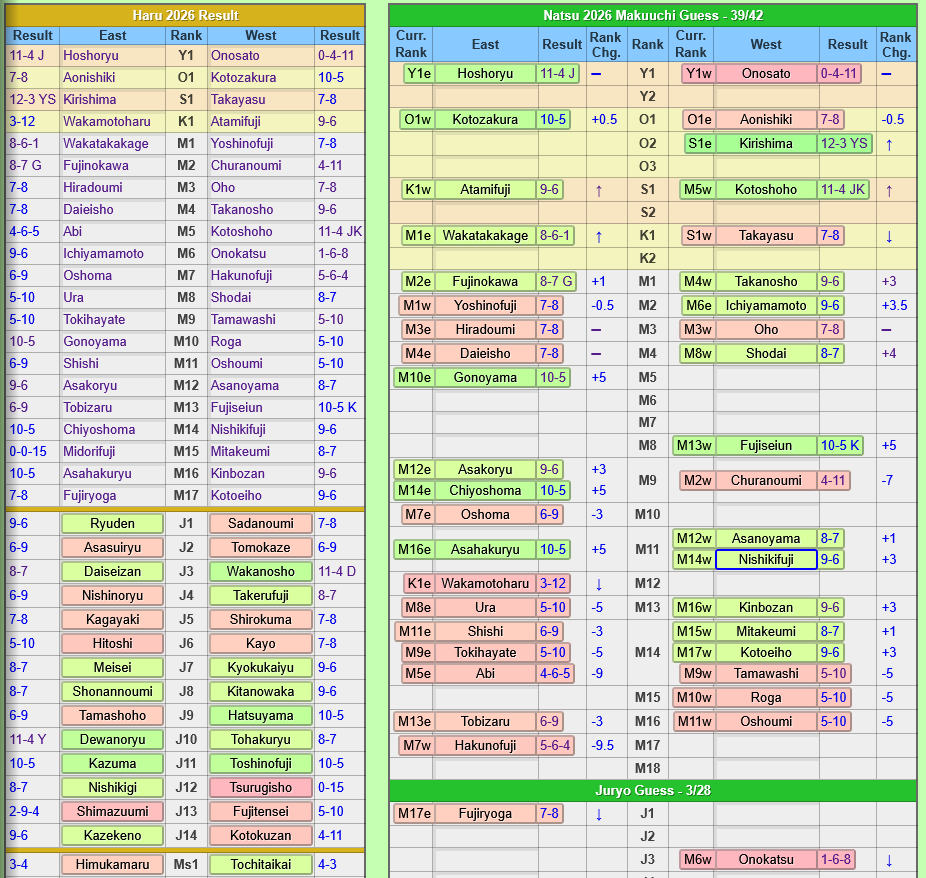
The only person here who hasn’t moved exactly in line with their win-loss record is Hakunofuji. With Kirishima ascending to ōzeki, and thus there not being a balanced number of ōzeki, we’re going to have an imbalance at the bottom of the banzuke, too. That means the top division is going to cap out at M17e in May. There will not be a M17w position.
Step 5: Time to bring up our juryo guys
Ryūden and Wakanosho are the only guys who’ve done enough to get promoted. That would be true even if the entire bottom of the makuuchi hadn’t all done so well. I’ll move them up now.
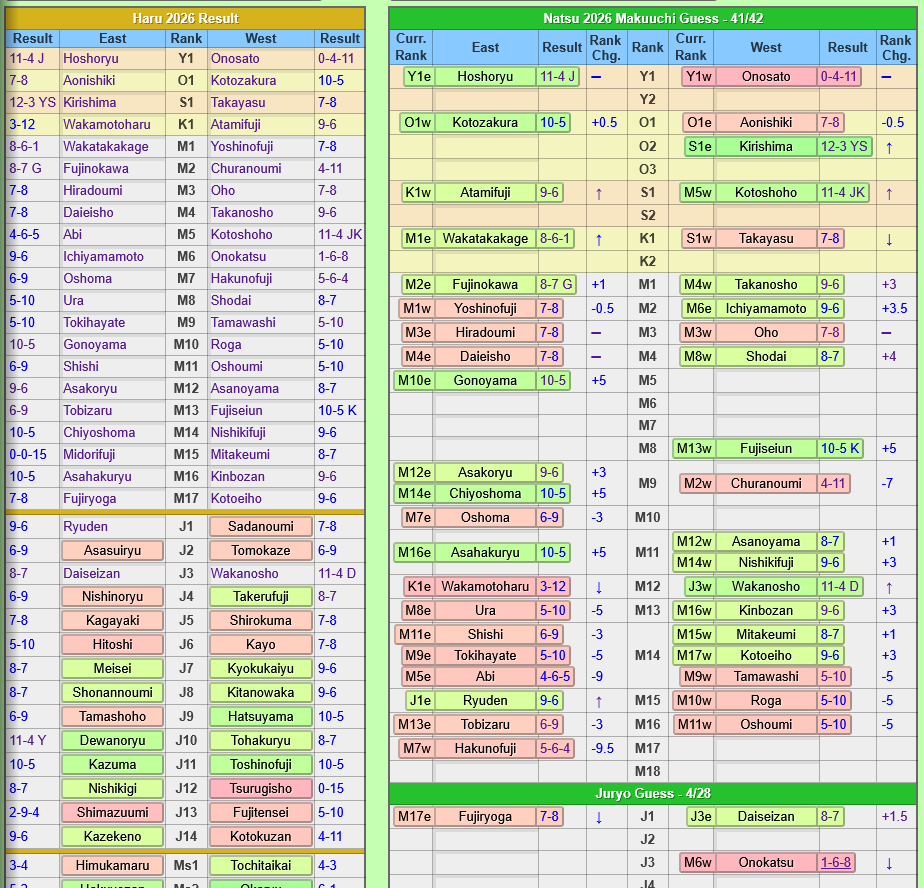
What a mess…
Step 6: Make it make sense
The next thing I want to tackle is that wide gap between M5w and M8e. To fill that I need to under-demote and over-promote some guys. The most obvious candidates for under-demotions are Wakamotoharu and Churanoumi, since they were in the san’yaku and jōi, respectively. The Japan Sumo Association has shown that they will be lenient with guys in those rankings who end up with terrible records (due to fighting a murderers row of opponents).
So I’m moving Wakamotoharu to M5w and Churanoumi to M6e. I’m still left with a pretty big gap after that, though.
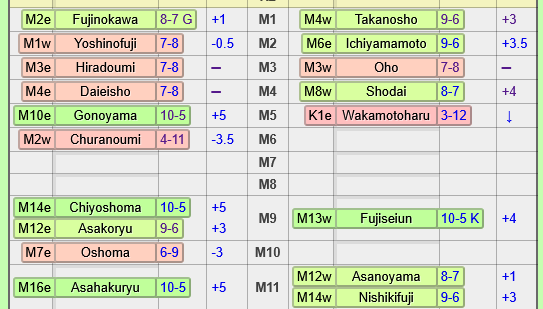
I really don’t want to move all those green guys up to fill those gaps, but I’m going to have to. First, though, I’ll demote Ōshōma the least amount possible. You could leave him at his previous rank, but that feels wrong on 6-9. I’ll demote him half a rank to M7w, instead.
Now I just have to suck it up and move up everyone else with winning records. That gives me this:
