

The 2026 natsu basho is a wrap!
And, despite how it started, we had a very exciting and captivating finish to this tournament. Things got off to a rocky start with those massive injury absences, but a very competitive field (with an eclectic range of characters) made the second week of this tournament extremely watchable. And there were fantastic matches, too.
On our final day there were seven wrestlers who had a mathematical chance to win the cup and there was the possibility of a six-way play-off.
Scroll down to see how everything panned out. I’ve got all the results from makuuchi, along with plenty of videos and my analysis for you to enjoy. But, wait… that’s not all!
For this tournament I’ve been breaking down the jūryō action for premium subscribers. On this final day, I’ll have jūryō (and even makushita) content for all.
So please enjoy this last tournament update.
Also, if you’ve enjoyed my coverage of this tournament up until now, please consider picking up a paid subscription. If you get one this month, you’ll receive a special 15% discount. Paid subscriptions keep the lights here and also encourage me to keep pumping out sumo content.
For those of you who already have those subscriptions, thank you so much for supporting my work and enabling me to create this space. And, to all readers, thank you for reading and watching this basho along with me.
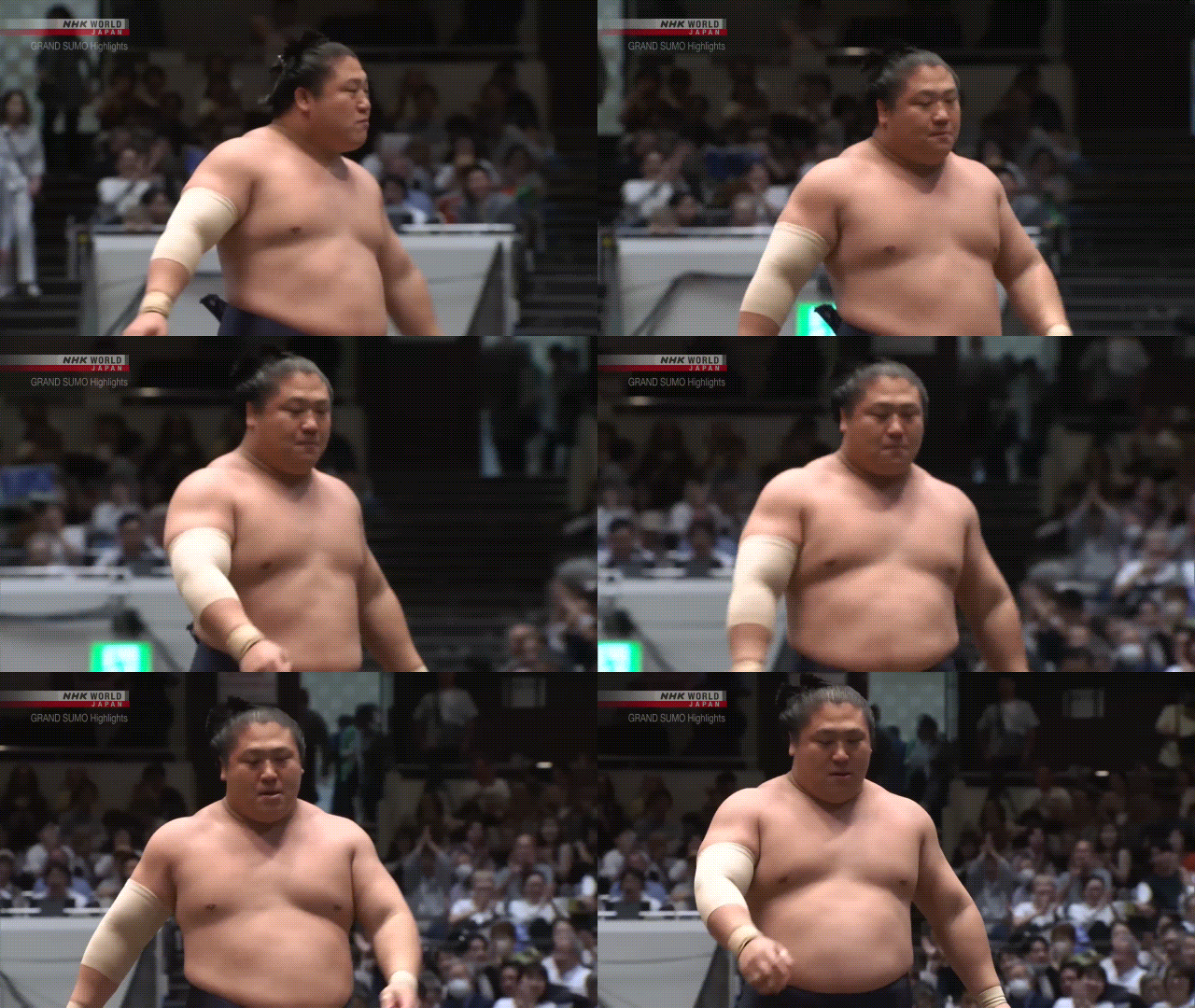
Our bonus gif today features someone who really takes this stoicism stuff seriously. It’s Wakatakakage.
Take advantage of my May sale to get 15% off a Sumo Stomp! subscription (for life!)
SPOILERS BELOW
>
>
>
>
>
>
>
>
Makuuchi Results & Analysis
Results
Dewanoryū (7-8) def. Ōshōumi (4-11) by shitatenage (underarm throw)*
Shishi (6-9) def. Ryūden (5-10) by yorikiri (frontal force out)
Kinbōzan (6-9) def. Tobizaru (9-6) by oshitoashi (frontal push down)
Nishikifuji (5-10) def. Tokihayate (4-11) by hatakikomi (slap down)
Wakanoshō (9-6) def. Asahakūryū (5-10) by tsukiotoshi (thrust down)*
Hakunofuji (11-4) def. Fujiseun (7-8) by hatakikomi*
Rōga (9-6) def. Gōnoyama (8-7) by yoritoashi (frontal crush out)
Daieishō (7-8) def. Mitakeumi (8-7) by tsukiotoshi*
Ōhō (9-6) def. Abi (5-10) by tsukidashi (frontal thrust out)
Hiradoumi (7-8) def. Tamawashi (2-13) by yorikiri
Ichiyamamoto (6-9) def. Shōdai (6-9) by oshidashi (frontal push out)
Yoshinofuji (11-4) def. Kotoeihō (10-5) by yorikiri
Takanoshō (7-8) def. Chiyoshōma (5-1) by hatakikomi
Fujinokawa (7-8) def. Wakamotoharu (5-10) by hatakikomi
Wakatakakage (12-3) def. Fujiroyga (10-5) by katasukashi (under shoulder swing down)*
Kotoshōhō (9-6) def. Churanoumi (9-6) by hikiotoshi (hand pul down)
Atamifuji (9-6) def. Ōshōma (8-7) by oshidashi
Kirishima (12-3) def. Ura (10-5) by oshitaoshi*
Play-off
Wakatakakage def. Kirishima by oshidashi*
*Must see bouts!
If you’re unable to pick up a paid subscription to Sumo Stomp! but would still like to tip me for these posts, please consider buying me a coffee below (via PayPal).
Tournament Champion and Prize Winners
Makuuchi champion: K1e Wakakatakage (12-3)
Kanto-shō (Fighting Spirit Prize): M2e Yoshinofuji (11-4), M10w Hakunofuji (11-4)
Gino-shō (Technique Prize): K1e Wakatakakage (12-3)
Analysis
Wakatakakage is your Grand Sumo top division champion for May 2026! The younger Waka Bros. defeated Kirishima in a play-off to take home his second career yushō. Three years ago Wakatakakage sat out the May tournament after suffering a catastrophic knee injury in the previous tournament. That resulted in him being demoted all the way down to makushita. Since then he’s clawed his way up the ranks and done his best to resume the career path that had many thought would result in an ozeki promotion or perhaps even yokozuna promotion.
This yushō doesn’t make up for the time lost, but it is still a feelgood moment and something all sumo fans can enjoy (even if you’re a big Kirishima fan, like me).
I’m going to analyze Wakatakakage’s play-off win over Kirishima, but first, I want to go through how we got to that point.
As stated earlier, this tournament could have ended up with a six way play-off since so many other wrestlers had a shot at being champions last night.
Hakunofuji was the first man on the dohyō whose bout had championship repercussions. He came into his bout with Fujiseun knowing he needed to win to stand a chance of getting into a play-off (which would only happen if Wakatakakage and Kirishima then lost their scheduled matches).
The stakes involved in this match prompted Hakunofuji to perform a henka on poor Fujiseun (who was dropped to 7-8 as a result). It was a lovely henka, though. I think it might be the first one I’ve ever seen Hakunofuji perform.
That sneaky win kept Hakunofuji from being eliminated in the title chase. The move didn’t win him any friends at the Japan Sumo Association, though. JSA Chairman Hakkaku publicly criticized the move, saying he was disappointed in Hakunofuji. I’m starting to feel like there’s not much Hakunofuji (whose career will always be tied to JSA public enemy number one Hakuhō) can do right in the eyes of Hakkaku and the others behind the ouster of the sport’s undeniable GOAT.
Hakkaku’s criticism aside, Hakunofuji did what he felt he needed to do to keep himself in with a shot at his maiden yushō. He then got to sit back and watch what his teammate Yoshinofuji would do.
Sumo Stomp! is entirely human made. Please continue to support human made writing and art over AI generated content.
Icon by HINOKODO (link).
Yoshinofuji and Kotoeihō were tied on wins coming into their final day bout. They knew they needed to win to be in the same situation as Hakunofuji and that a loss would officially eliminate them from the title run.
The bout itself wasn’t very competitive. Yoshinofuji was much stronger than Kotoeihō in the clinch and he had him back-peddling quickly. Kotoeihō didn’t look comfortable in that clinch and was bundled out despite Yoshinofuji having neither a very firm right outside grip on the belt nor a tight underhook with his left.
That result now meant that Yoshinofuji and Hakunofuji would be in a hypothetical play-off should Wakatakakage and Kirishima lose. This would have also presented the chance of Yoshinofuji and Hakunofuji wrestling each other, something teammates can only do during a play-off situation.
The chances of seeing an Isegahama derby on the final day were squashed, though, when Wakatakakage won his scheduled match with Fujiryoga. That result meant that, from that point on, only Wakatakakage or Kirishima could win the title. Had Wakatakakage lost, then he and Fujiryoga would have been tied with Yoshinofuji and Hakunofuji and would have to wait and see if Kirishima lost to set up a big play-off.
Wakatakakage erased that possibility with the same brutally effective sumo we’ve seen from him over the past few days. He gathered Fujiryoga off the tachiai and then set him up for a quick katasukashi.
Since losing to Kirishima on day eleven, Wakatakakage has made mincemeat of his opponents, finishing them all quickly. That list of opponents includes all men who, at the time of the bout, were fighting to stay in the title hunt (Gōnoyama, Tobizaru, Kotoeihō and Fujiryoga).
Wakatakakage’s win put a ton of pressure on Kirishima, who fought Ura in the last scheduled bout of the evening. If Kirishima lost he would have handed the title to his rival.
Had Wakatakakage lost to Fujiryoga, Ura would have been trying to beat Kirishima to force himself into a six-way play-off with Kirishima, Wakatakakage, Fujiryoga, Yoshinofuji and Hakunofuji. As things stood on the night, though, when his match came around he knew he was just fighting for honour.
Kirishima looked like the fighter with more to win (and lose) in this bout. And he handled Ura rather violently in the match. So much so, that it almost looked out of character for him.
He put Ura down with a sequence of moves that looked highly planned and designed for this situation. Off the tachiai, Kirishima used a right outside grip to pinch Ura’s left arm and then turn him away. That move was made to bait Ura into spinning back to face him. Immediately after the turn, Kirishima threw a kick, knowing it would push the rotating Ura off balance. He paired the kick with a short and sharp nodowa (throat thrust) to send Ura over his leg and sprawling into the dirt.
That win set up Kirishima’s play-off bout with Wakatakakage.
Want a free way to support Sumo Stomp! Help me get to 1,000 subscribers on YouTube (so then I can monetize the thing).
The play-off bout itself wasn’t a match for the ages. Wakatakakage steamrolled Kirishima, using the power of ottsuke (forearm blocking) to prevent Kirishima getting an inside position. Kirishima beat Wakatakakage on day eleven with a moro-zashi (double inside position). With paths to Wakatakakage’s belt/armpits blocked off, Kirishima had nothing to prevent him being stood up and bent backwards by a stiff Wakatakakage forearm shot to the chest. A second chop across the chest sent Kirishima into the seats.
When Kirishima returned to his mark, he gave Wakatakakage a little nod of the head before his traditional bow. There’s no bad blood in this match-up. Kirishima often trains at Wakatakakage’s Arashio stable, getting lots of practise matches in with him and his brother.
Wakamotoharu was next to Kirishima in the celebratory car ride back in March. This time, though, Wakamotoharu got to ride with his little brother. And he was also able to get Wakatakakage to crack a smile, too, for once (see it below).
Keeping count!
Henka counter: 11.5*
Tobi trample counter (rows): 8**
*Henka from Hakunofuji and Fujinokawa (over Wakamotoharu) take our final Henka count to 11.5. That’s 1.5 more than we got in March.
**Tobizaru got with the program in the last few days of this tournament. The eight rows touched here are a slight improvement on the six he trampled at the March tournament.
And now something extra… FOR EVERYONE!
Jūryō Results and Analysis
Results
Arashifuji (5-2) def. Ōkaryū (3-12) by yoritoashi (frontal crush out)*
Kayo (5-10) def. Tamashōhō (8-7) by oshidashi
Tōhakuryū (6-9) def. Toshinofuji (9-6) by oshidashi
Midorifuji (9-6) def. Kagayaki (5-10) by yorikiri*
Kazuma (12-3) def. Nishinoryū (7-8) by yorikiri*
Kitanowaka (8-7) def. Tochitaikai (8-7) by hikkake (arm grabbing force out)
Tomokaze (8-7) def. Shirokuma (7-8) by sukuinage (beltless arm throw)
Asasuiryū (10-5) def. Hitoshi (8-7) by oshidashi
Kyokukaiyū (9-6) def. Enhō (8-7) by abisetaoshi (backward force down)*
Hakuyozan (6-9) def. Hatsuyama (5-10) by yorikiri
Takerufuji (11-4) def. Meisei (7-8) by oshitaoshi
Sadanoumi (7-8) def. Nishikigi (5-10) by yorikiri
Daiseizan (9-6) def. Kazekeno (10-5) by tsukiotoshi
Ōnokats (9-6) def. Shonannoumi (9-6) by yorikiri
*Must see bouts!
Tournament Champion
J6e Kazuma: 12-3
Analysis
Kazuma if your jūryō champion this month. He beat Nishinoryū last night to avoid a possible play-off with Kazekeno (who was leading this tournament up until the previous night).
Kazuma had his work cut out for him, though. Nishinoryū was very sturdy off the tachiai and he did a good job of initially preventing Kazuma from getting an inside left position. Nishinoryū used hand-fighting to get Kazuma’s left paw off his belt a couple of times and then used ottsuke to keep the left hand away while also pushing Kazuma back. Kazuma was strong enough to put the brakes on, though. When Nishinoryū felt like he couldn’t move Kazuma back any more, he tried to break free. Kazuma’s hold on him was too tight, though. When Nishinoryū failed to get free, Kazuma was able to then get his left hand on the belt. After taking a breather, Kazuma then wrenched upwards and advanced, standing Nishinoryū up and backing him out for the win.
This was a great performance from Kazuma. And he showed a lot of maturity in this tournament, as he chased down and passed Kazekeno. This is only Kazuma’s eighth Grand Sumo tournament. With the yushō, the man from Kise heya (Ura, Kinbozan, Churanoumi) might have done enough to get promoted to makuuchi. That’s going to be a hard call, though, due to how everything else shook out in jūryō. I’ll dive into that later when I work on my banzuke prediction post.
After watching Kazuma win, Kazekeno slumped to his fourth loss in a row. He ran at Daiseizan last night and was slapped down rather easily. It felt like Kazekeno just wanted to get this one over with.
Enhō finished his jūryō return tournament with a loss to Kyokukaiyū. He got stuck in a close-quarter battle with Kyokukaiyū and couldn’t prevent himself getting marched out. At the end of this one Enhō seemed to collapse, awkwardly, and I feared he might have injured his knee. However, Enhō was up quickly and seemed to be walking OK. That result sees Enhō finish with an 8-7 record (after a 7-2 start to the tournament).
Takerufuji pretty much sealed a makuuchi return with a thundering crush out on Meisei (who dropped to 7-8 as a result). Takerufuji, who was sporting extra bandages on his right shoulder last night, came up looking like he was in a lot of pain. It would be tragic if Takerufuji did all this hard work to get back to makuuchi only to go kyūjō (absent) in Nagoya.
As it stands Takerufuji, Daiseizan and Ōnokatsu are locks for promotion. Asasuiryū and/or Kazuma are possibly going up, too.
Makushita and below
Tournament Champions
Makushita: Ms20w Ikarigata (6-1)
Sandanme: Sa6e Asahifuji (7-0)
Jonidan: Jd37w Shōsei (7-0)
Jonokuchi: Jk15e Hakugetsuro (7-0)
Analysis
Makushita was decided by a seven rikishi play-off featuring Tanji, Mudōhō, Ikaragita, Akua, Tshushimanada, Toshunryū and Omori.
See that mini tournament below.
The first bout, determined by a random draw, was 22 year-old super prospect Omori, whose hair isn’t even long enough to be slicked back, taking on the teenager Ikarigata. Ikarigata bulldozed into Omori and put him out with a tsuridashi (frontal lift out). That advanced him to the next round.
Next up was the 27 year-old Toshunryū against the 24 year-old Mudōhō (younger brother of Ōhō and grandson of 48th yokozuna Taihō). The bigger Mudōhō looked a lot like his brother in this match, thrusting Toshunryū out rather quickly.
After that was Tanji against Akua. Tanji is 19 and from Arashio heya (Wakatakakage, Wakamotoharu). He went viral a few years ago for clowning on NFL star Micah Parsons. The 35 year-old Akua is a former jūryō veteran from Hōshōryū’s Tatsunami beya. He has recently performed the role of bow twirler and is also known for a gigantic salt toss before his bouts. Akua did his best Hōshōryū impression in this bout, putting Tanji down with an uwatenage that featured a very high leg kick.
In the next round Ikagarita met Mudōhō. The smaller and faster Ikagarita was able to get around Mudōhō’s thrusts and push him out from the side.
Then Akua met Tsusushimada. Tsusushimada received the free pass from the first round (due to there being an odd number of participants). He’s 32, from Sakaigawa heya (Hiradoumi, Sadanoumi) and he’s spent a little time in jūryō before. Akua looked like a freight train in this bout, powering Tsusushimada out to set up a final with Ikaragita.
In the final Ikaragita used a henka! That saw Akua sail past him and go sliding into the dirt. Ikaragita’s makushita yushō was met with plenty of grumbles from the crowd (likely due, in part, to how popular Akua is).
Asahifuji won the sandanme yushō with a play-off win over Kiryuko. He won that bout with a confident kotenage (armlock throw) followed by a slight stare down.
The 24 year-old Mongolian was given the name Asahifuji by Isegahama oyakata (stablemaster). That’s the former Terunofuji. Asahifuji is the name of the 63rd yokozuna and the previous Isegahama oyakata (Terunofuji’s mentor). At the time it felt like that was a lot of pressure to put on the newcomer, who made his debut this January.
Asahifuji has been flawless in Grand Sumo so far, though. He’s undefeated after three tournaments and looking like a lock to be featured in makuuchi in the near future.
18 year-old Shōsei won the jonidan yushō with a 7-0 record. That was his second senior tournament.
24 year-old Mongolian Hakugetsuro won the jonokuchi yushō with a 7-0 record. That was his debut tournament.
OK, that’s everything. The 2026 natsu basho has now been put to bed and that’s where I’m going, too, after I hit send.
Next up from me are report cards, banzuke predictions and spotlight post on Wakatakakage (yep, I’m bringing those back).
Thank you everyone for reading, sharing, commenting and sticking with me for the past fifteen days. I’ve loved watching this tournament and writing about it, too.
Take care, be kind and FIGHT WITH SPIRIT!
Tim
Thank you as always, Tim!!
Wakatakakage’s smile looks pained lol