

Hello everyone.
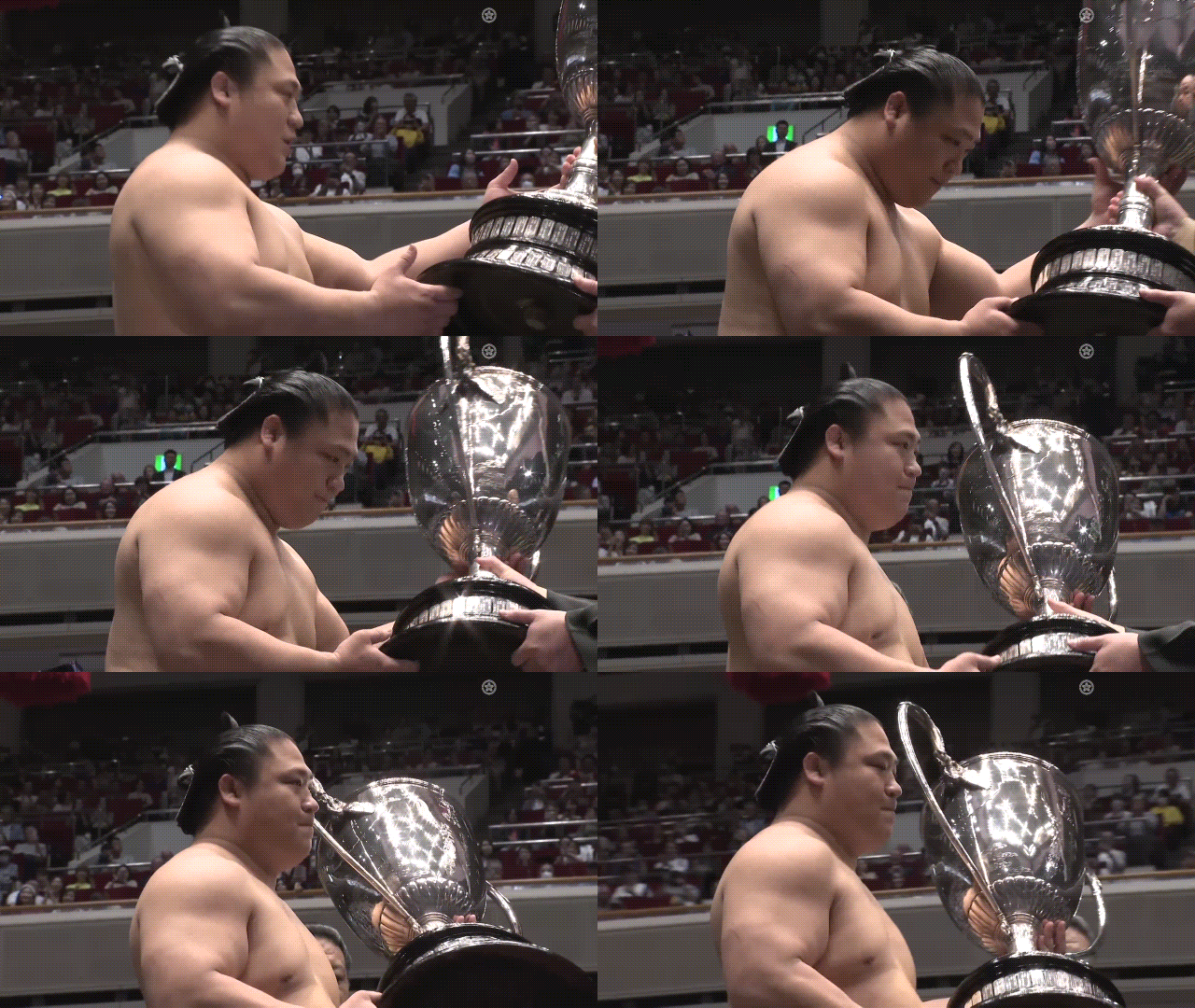
The Nagoya Basho will be here in just a few days. But before that happens, let’s take our last look back at the 2026 May tournament, where Wakatakakage scooped his second career yushō.
This is my first Spotlight post since the November, 2024 tournament. That post was, coincidentally, about Wakatakakaage, also. Back then I broke down his Technique Prize winning tournament, which came pretty soon after he returned to the top division.
This will be a detailed and crunchy post looking at the ins and outs of Wakatakakage’s technique over the last tournament. This is a premium post so I will be putting a pay-wall at around the three quarters mark.
These pay-walls are tricky things. I want as many of you as possible to read as much of this as possible, but I simply have to give extra to those who stump for the paid subscription (as a thank you and as an exchange for what you’re kindly contributing).
Those paid subscriptions are what keep Sumo Stomp! alive. If I didn’t have them it would be very hard to produce the amount of content I currently do for this blog. If you haven’t picked one up already, and you like what I do, please consider grabbing one. I keep the price on these as low as Substack will let me. Frankly, I feel weird about doing it any other way. Sumo is already a hard sport to follow and I don’t want to make my stuff hard to pay for.
OK, sales pitch over. Let’s get onto the man of the hour, the awesome and resolute Wakatakakage.
Day 1: Wakatakakage def. Hiradoumi via tsukiotoshi
Wakatakakage opened his 2026 natsu basho tournament with somewhat of a softball. Hiradoumi is a good, not great, wrestler, but he’s still capable of being a tough out. Wakatakakage has always had his number, though. He was 7-2 against Hiradoumi heading into this bout and, in the last tournament, he beat him rather easily with a confident uwatenage (overarm throw). Despite the odds being so high in his favour for this bout, Wakatakakage didn’t want to take any chances. Instead he went with a henka.
Was it a henka, though?
Yes, Wakatakakage quickly side-stepped and let the poor Hiradoumi run himself off the ring. Wakatakakage did take some chest contact before it happened. I like to call this kind of a sequence a half henka, personally. Though, I don’t think it’s that much different from the teleportation style henka we see someone like Abi do where they takes zero contact off the tachiai. I don’t think Wakatakakage opting for that chest clash is a display of toughness. I think allowing the contact is a ploy to better disguise the inashi (side-step). It’s also hard to know for sure if Wakatakakage chose to make contact in this bout. Hiradoumi’s speed off the line might have made that decision for him.
Either way, Wakatakakage scored the tsukiotoshi (thrust down) win to start his campaign. In the moment, I didn’t think much of it. In hindsight, it’s a bit of an inglorious way to start a yushō winning tournament. However, his heroics later on in the tournament will more than cancel that out — in my opnion.
Day 2: Wakatakakage def. Kotozakura via yorikiri
On day two Wakatakakage came up against Kotozakura, someone he has a lot of history with. It was against Kotozakura (then named Kotonowaka) that Wakatakakage suffered the brutal ACL injury that would put him out of action for half a year and derail his best push for an ōzeki promotion.
The injury was caused when Wakatakakage attempted something similar to an utchari (backwards pivot throw), while being pushed towards the straw. The strain of lifting and turning Kotozakura is what popped his knee ligaments. It should be noted that Wakatakakage won the torinoashi (rematch) that came after that injury. That’s a pretty good example of how tough he is, both physically and mentally.
Since then, Wakatakakage has been very mindful of Kotozakura’s size and heft. I’ve seen him bail on the utchari in subsequent bouts, smartly recognizing that it’s not worth trying to lift all that weight. In this bout Wakatakakage avoided getting himself into that kind of dilemma by making sure he wasn’t taking a backwards step. I wouldn’t be surprised if Wakatakakage has that as a rule now, when facing this particular opponent.
In this bout, Kotozakura got off to a good start, reaching inside with his favoured right arm. That put Wakatakakage on the defensive, immediately. He used ottsuke (forearm blocking) to crush against Kotozakura’s right and prevent him establishing a comfortable migi-yotsu (right arm inside position).
While working the ottsuke with his left, he used his right to push against Kotozakura’s chest. This got Kotozakura to the straw. When Wakatakakage got him there he moved the right hand down to the belt. This gave him a migi-yotsu and a sashite (belt grip on the inside position). That switch gave Kotozakura a window of opportunity to force Wakatakakage back. Wakatakakage responded to this with a belt grip with his left hand. This double gripped position is a commanding position for anyone.
The grip allowed Wakatakakage to lean back and safely elevate Kotozakura (without the kind of torque that popped his knee). Wakatakakage might be, pound-for-pound, the strongest man in the sport, so he can move anyone from this position. It took a few tries, but he was able to get Kotozakura back and also use the position to prevent Kotozakura from rotating him on the edge.
This was an extremely smart fight from Wakatakakage and it gave us a great chance to see his defensive skills, too. He’s often on the attack, but this reminds us that he’s got great reaction speed and a tremendous Fight IQ.
Day 3: Wakatakakage def. Yoshinofuji via yorikiri
After beating an old pro on day two, Wakatakakage faced a young blood on day three. This was only his fourth ever bout with Yoshinofuji and it ended like all the other ones did, with the gyoji (referee) pointing his gunbai (fan) at Wakatakakage.
This bout opened with a pretty big clash of heads. Wakatakakage seemed to wince in response to that. Yoshinofuji then tried to get a hand on Wakatakakage’s throat, but Wakatakakage pushed his elbow to force his hand away. That move served a double purpose. It pushed away Yoshinofuji’s nodowa (throat thrust) attempt and also opened up a path for Wakatakakage to get his favourite migi-yotsu.
Once he had the right arm inside position he was able to put his chest on Yoshinofuji and power him out.
After he got Yoshinofuji over the line, Wakatakakage gave an extra shove to force Yoshinofuji to hop to the ground below. Wakatakakage then gave a little look. This happened in their bout in March, too. This might be a sign of some animosity between the two. If that’s the case, I don’t know the root of it.
Either way, this quick win kept Wakatakakage perfect against Yoshinofuji and perfect at this basho.
Day 4: Wakatakakage def. Daieishō via oshidashi
On day four, Wakatakakage was presented with his first pusher/thruster of the tournament in the form of Daieishō. These two have spit their twenty or so matches over the years. Wakatakakage had won the previous two bouts before this meeting, though.
When a grappler, like Wakatakakage, meets a pusher/thruster, like Daieishō, they are presented with a conundrum when it comes to the tachiai. The grappler wants to get their arms on the inside and hands on the belt. To do that, your hands need to go low. When you do that, you give the pusher/thruster exactly what they want — an open path to your chest and/or throat. If you start your tachiai with your hands high, to defend against those opening thrusts, then you might lose your opportunity to get inside and on the belt.
Kirishima has the perfect approach to this, in my opinion. He often opens with defensive swipes at the pusher/thrusters’ elbows and then, after rotating the opponent, steps in and gets inside.
In this bout Wakatakakage opted to start low, giving up his chest and throat to Daieishō. Wakatakakage did this, I think, because he is very confident that he can withstand the pressure of palm strikes. And that’s just what he did in this bout.
Daieishō landed well off the tachiai, but he couldn’t push Wakatakakage back. After a few shots, Wakatakakage pushed the elbow away to find an angle to go inside. But Daieishō’s pace allowed him to keep firing and not let Wakatakakage close distance. Wakatakakage performed a second elbow push and then went with hazuoshi (armpit thrusting). Daieishō was a great candidate for that move given how high his arms were and how his rapid fire style means those arms don’t come down between thrusts.
With a firm hand under Daieishō’s armpit, and another under the chin, Wakatakakage was able to bend Daieishō back and get him out to continue his perfect start to the basho.
Day 5: Takanoshō def. Wakatakakage via hatakikomi
On day five Wakatakakage was presented with a similar, though not identical, problem as he had on day four. Takanoshō is a pusher/thruster, but he favours long and strong thrusts, not the short and rapid shots that Daieishō throws. Takanoshō is also much taller than Daieishō (and Wakatakakage) so his angle of approach is different. Like Daieishō, Takanoshō also has a 50 percent win ratio against Wakatakakage, though he’s lost the last two.
Despite Takanoshō being different from Daieishō in some key areas, Wakatakakage approached him in the same manner as he did Daieishō on the previous day. He came with hands low, confident he could take the opening thrusts of his opponent. I liked the toughness and confidence he showed while doing this against Daieishō, but I think that confidence was misplaced here against a man with so much reach and height on him.
Takanoshō’s long reach meant he was able to connect with a big thrust, while also keeping his body far away from Wakatakakage. He was too far away for Wakatakakage’s hands to reach his belt. Wakatakakage tried to cover the distance to remedy this, but that’s when Takanoshō did what a good pusher/thruster does in this situation — he extended the distance Wakatakakage had to cover and then pushed him down as he tried to cover it.
Wakatakakage might have been more successful if he approached the tachiai looking to immediately defend against those out-stretched arms of Takanoshō. His failure to do that resulted in his first loss of the tournament. Thankfully, for him, those losses would be few and far between, though.
Day 6: Wakatakakage def. Fujinokawa via yorikiri
After facing some of the biggest bodies around in the division, Wakatakakage had a smaller opponent to deal with on day six. What Fujinokawa lacks in size, though, he more than makes up for with activity and aggression. This was only the second time Wakatakakage had faced Fujinokawa. He won their first meeting, in March.
Fujinokawa is great at unsettling his opponents with pressure and violence. We often see larger, more demure, wrestlers wilt from that pressure and let themselves get pushed around by the little bulldog. That game doesn’t work on someone like Wakatakakage, though.
Wakatakakage fights with a lot of intensity, too. And he’s never shown us anything that suggests he would turn away from a brutal dogfight. He’s also too compact for Fujinokawa to get underneath. Fujinokawa likes fighting bigger guys, because he can really snuggle into them and buck up into their torsos.
In this bout Fujinokawa shaped himself into a missile at the tachiai, hoping to rock Wakatakakage at the outset. Wakatakakage took the hit, though, and placed his shoulder right on Fujinokawa’s nose. In the opening clash Wakatakakage was also able to get an outside grip with his left hand. He was trying to get the migi-yotsu, too, but Fujinokawa’s tight left arm prevented that.
Wakatakakage didn’t waste precious time fighting for the right inside position after it was initially blocked. Instead, he worked with what he had. He circled towards his outside grip, rotating Fujinokawa. He tried to get his right arm free during this, but Fujinokawa did a good job of keeping that pinched.
When they came to rest in the centre of the ring, Fujinokawa made the mistake of shaping for a throw that would never happen. Wakatakakage easily blocked that and then tried to drag Fujinokawa down with that still locked on outside grip. Fujinokawa, again, did a good job of staying upright, but Wakatakakage’s right arm was now mostly free. Wakatakakage used his right for hazuoshi (like what we saw on Daieishō). It took a couple of attempts, but he was eventually able to force Fujinokawa out with that.
Wakatakakage had that outside grip secured from the second this bout started to the second it ended. That control helped him keep Fujinokawa on the defensive, which is a great way to neutralize the little man’s hyper-aggressive game.
Day 7: Wakatakakage def. Ichiyamamoto via oshidashi
Wakatakakage followed up his prolonged bout with Fujinokawa with a lightning quick win over Ichiyamamoto (his most famous fanboy). This was another pusher/thruster opponent for Wakatakakage and he approached him with his hands down, again.
However, those low hands swung upwards with his tachiai, and landed in Ichiyamamoto’s armpits. The timing on this was impeccable. That swing allowed him to get under Ichiyamamoto’s outstretched arms and reach the pits before Ichiyamamoto was able to extend for his opening thrusts.
Once Wakatakakage got to Ichiyamamoto’s armpits, Ichiyamamoto tried to hop away for a slap down, but Wakatakakage was in too tight and covered the distance quickly (which was short, not like the runway Takanoshō made for him).
This tied Wakatakakage’s record with Ichiyamamoto at 3-3 and gave him a 6-1 record on the basho.
Day 8: Wakatakakage def. Ōhō via yorikiri
Another pusher/thruster! And this time, someone with the size and weight of Takanoshō. Ōhō doesn’t have the same kind of track record Takanoshō has, though. He came into this bout trailing Wakatakakage 2-7 in their head-to-head meetings.
Wakatakakage started with hands low, again, in this bout. Ōhō is notably terrible when someone has a hold of his belt, so that’s why Wakatakakage would be especially interested in immediately securing a belt grip on him.
Like with Fujinokawa, Wakatakakage got his outside left grip locked on immediately. This time, though, he came within an inch of securing his inside right grip, too. Ōhō was able to raise Wakatakakage’ right arm just before our man got his fingers under the silk, though.
Just like with Fujinokawa, Wakatakakage didn’t waste time continuing to fight for the inside position. When Ōhō tried to crunch his arm there, he pulled it out and started circling to his left to rotate Ōhō.
Ōhō doesn’t have the speed of Fujinokawa, so he did a much poorer job of defending while being rotated. Wakatakakage pulled Ōhō to the boundary and then turned himself to face him. As he did this, Ōhō put his right arm over Wakatakakage’s left. This turned Wakatakakage’s left arm outside position into an inside position. That was a mistake since it allowed Wakatakakage to narrow that grip to a mae-mitsu (front grip) and then use it to drive Ōhō back. Wakatakakage got his right arm on the inside, too, giving him moro-zashi (double inside position). There was little Ōhō could do at that point.
The speed at which Wakatakakage can initiate a grappling exchange is a big reason why Ōhō has so much trouble with him.
Day 9: Kotoshoho def. Wakatakakage via yorikiri
Guess what? Another pusher/thruster.
Kotoshōhō has the size of Takanoshō and the speed of Daieishō. On his good days, that combination makes Kotoshōhō a hard out for anyone. And he’s had lots of good days against Wakatakakage. Wakatakakage has only managed to beat Kotoshōhō once in now seven meetings.
Wakatakakage approached this bout just like on previous days, with hands swimming down, looking to come up and get inside position on the right side. He timed it perfectly with Ōhō. But this time, Kotoshōhō was ready for him. In the tachiai Kotoshōhō opened with thrusts to Wakatakakage’s shoulders. That totally disrupted Wakatakakage’s swimming motion. If that was intentional, then that’s a very heady play from Kotoshōhō (someone whose fight IQ sometimes looks lacking).
Kotoshōhō’s opening thrust sent Wakatakakage sliding on his heels. That should be a good reminder that Kotoshōhō is very underrated when it comes to his size and pushing power. Wakatakakage reset after that and tried to come in again with that swimming motion. He managed to get his right arm on the inside, but Kotoshōhō pushed on his shoulder again and was able to prevent Wakatakakage from locking onto the belt.
After this Wakatakakage conceded on that side, as we’ve seen him do in previous matches, and then focuses on the left outside grip. He snatched that up and then started to rotate — like he did with Ōhō and Fujinokawa.
Kotoshōhō used great footwork to make sure he didn’t get turned around like those guys did. He moved laterally, to stay face to face with Wakatakakage. That prevented Wakatakakage from getting around Kotoshōhō and putting Kotoshōhō’s back towards the straw. This also resulted in Wakatakakage’s back being towards the straw. Kotoshōhō needed just a little shove to put Wakatakakage’s feet over the line for the win.
It’s hard to criticize Wakatakakage for this loss. Kotoshōhō fought a great fight and he seems to have Wakatakakage’s number. If I’m being extra mean, I could say that Wakatakakage might have suffered from being a little too predictable in this bout, since his opening move was pretty identical to his bouts on the past couple of days.
Day 10: Wakatakakage def. Atamifuji via yorikiri
On day ten Wakatakakage got a break from the pusher/thrusters and was instead given a big, heavy yotsu-zumo (belt grappling) specialist. And this was one of the best bouts of the entire tournament.
This was only the third meeting between Wakatakakage and Atamifuji. Wakatakakage won their first two bouts, but lost their match in March. In that recent loss, Wakatakakage attacked with a deep inside right position. His hand, in that bout, was almost on the knot in the middle of the belt. He tried to rotate Atamifuji from that position, but Atamifuji was too heavy and was able to throw him down with a kotenage (armlock throw) on the boundary.
Wakatakakage went with a different approach in this bout. He went with the mae-mitsu (shallow front grip) off the tachiai. And he immediately found that more successful than his previous deep grip. By wrenching up and pulling back, he was able to get Atamifuji’s feet moving.
He tugged Atamifuji to the straw and then released the mae-mitsu and transitioned to moro-zashi for the attempted push out. Atamifuji defended really well, though, with footwork. He circled away from the straw and then executed a makki-kae (switch from outside to inside position) with his right arm. This high risk move took away Wakatakakage’s moro-zashi and put them both in migi-yotsu. That’s what both men prefer.
At this point of the match, things were looking like the March bout. And Atamifuji went for an armlock with his outside left in about the same position he finished Wakatakakage in that earlier bout. Wakatakakage was able to fend off the throw here, though, by sliding his feet to the straw and getting as much of his body in front of Atamifuji as possible.
They paused in the middle after that, just briefly. Atamifuji broke the pause by attacking with his gaburi-yori (torso thrusting). He got Wakatakakage moving back, but then Wakatakakage did something quite brilliant.
He timed Atamifuji’s hug-and-chugs and elevated Atamifuji on the chug. This was brilliant, because when Atamifuji is at that part of the sequence his feet are almost off the ground (slow the video down to 0.25 speed to get a real good look at that). This made it easier for Wakatakakage to lift him. Lifting and turning Atamifuji is still a Herculean task; Atamifuji is one of the heaviest wrestlers in the division. But by targeting and timing Atamifuji’s gaburi-yori Wakatakakage was able to manage it and score a very big win.
Day 11: Kirishima def. Wakatakakage via yorikiri
On day eleven, Wakatakakage got his toughest opponent of the tournament. Kirishima was the second highest ranked man left in the tournament at this point (though the man above him, Kotozakura, was a total non factor). And Kirishima was also operating at the same level that saw him cruise to the title in May. Wakatakakage also came into the bout having lost the four previous meetings to the Mongolian. Their overall record, at this point, was 14-9 in favour of Kirishima.
It should also be noted that Kirishima and Wakatakakage are very familiar with each other. Their stables are in the same ichimon (stable group) and Kirishima, whose small stable has no other sekitori (salaried wrestlers) in it, often trains over at Arashio. Wakamotoharu even sat next to Kirishima on his triumphant car ride in May.
Both men knew very well that they both prefer the same hold, migi-yotsu. And they both went for that when this bout started. Kirishima was able to get his right hand to the inside, with his elbow angled high so he could dart his hand inside of Wakatakakage’s arm (which Wakatakakage had kept tight to his side). Kirishima was also able to block Wakatakakage getting his right arm on the inside, by pinching his left arm very tight and swimming his left arm up towards Wakatakakage’s arm pit.
This was leading to Kirishima having a moro-zashi position. Wakatakakage didn’t want that, so he pulled the ripcord and shot back. Kirishima advanced and tried to take advantage of Wakatakakage backwards movement. As Wakatakakage braced for the push, Kirishima then scored the moro-zashi.
This wasn’t an ordinary double inside position, though. Kirishima had a mae-mitsu grip on the right side. This position gave him a lot of freedom with his right elbow. He used that elbow to break Wakatakakage’s defensive grip on his belt. He kept his elbow and forearms moving and was able to prevent Wakatakakage settling into any kind of grip. That allowed Kirishima to shuffle Wakatakakage back and eventually out.
This was a typically classy and composed performance from Kirishima; the kind we see when he’s in championship form. The loss was huge in the title race, too. This put Kirishima one win ahead of Wakatakakage with four days left. From this point on Wakatakakage would have to be perfect to get back in the race. And… of course, we know he was.
Day 12: Wakatakakage def. Gōnoyama via tsukiotoshi
Wakatakakage came into day twelve needing to win. He had to bounce back from the Kirishima loss and he had to feel that another loss in this tournament would totally kill his chances of the yushō.
In this situation, Wakatakakage took the easy route. …
Subscribe to keep reading this premium post, which includes breakdowns of Wakatakakage’s crucial bouts with Tobizaru, Kotoeiho, Fujiryoga and then his play-off with Kirishima (and the adjustment he made to win the title!)
