

Report Card: 2026 Hatsu Basho - Part 1
Grading the top division rikishi who were involved in the January tournament.
Hi everyone. It’s been a while. I hope your memories of the January basho are still fresh (it really was a great tournament) and the longing for the March basho isn’t weighing you down too much. I would love some fresh sumo action now, especially when it’s so grim here in icebound Toronto.
Since there is no new sumo to focus on, this report card covering the New Year tournament will have to do. Scroll down to see my reports on the wrestlers ranked maegashira 17 to 11. Among that cohort we have some surprise contenders, including Oshoumi and Abi, and some real strugglers, including Hatsuyama and Tomokaze. Check out how I graded them all below!
This is a premium piece so you’ll have to have a paid subscription to read all the reports. I try and keep the paywall placed pretty low in these pieces, though. I also keep my subscription prices as low as Substack will let me.
Paid subs do help a great deal right now. If you’d like to support my work, please consider kicking in a few coins.
Our bonus gif for this article is the Troll King himself.
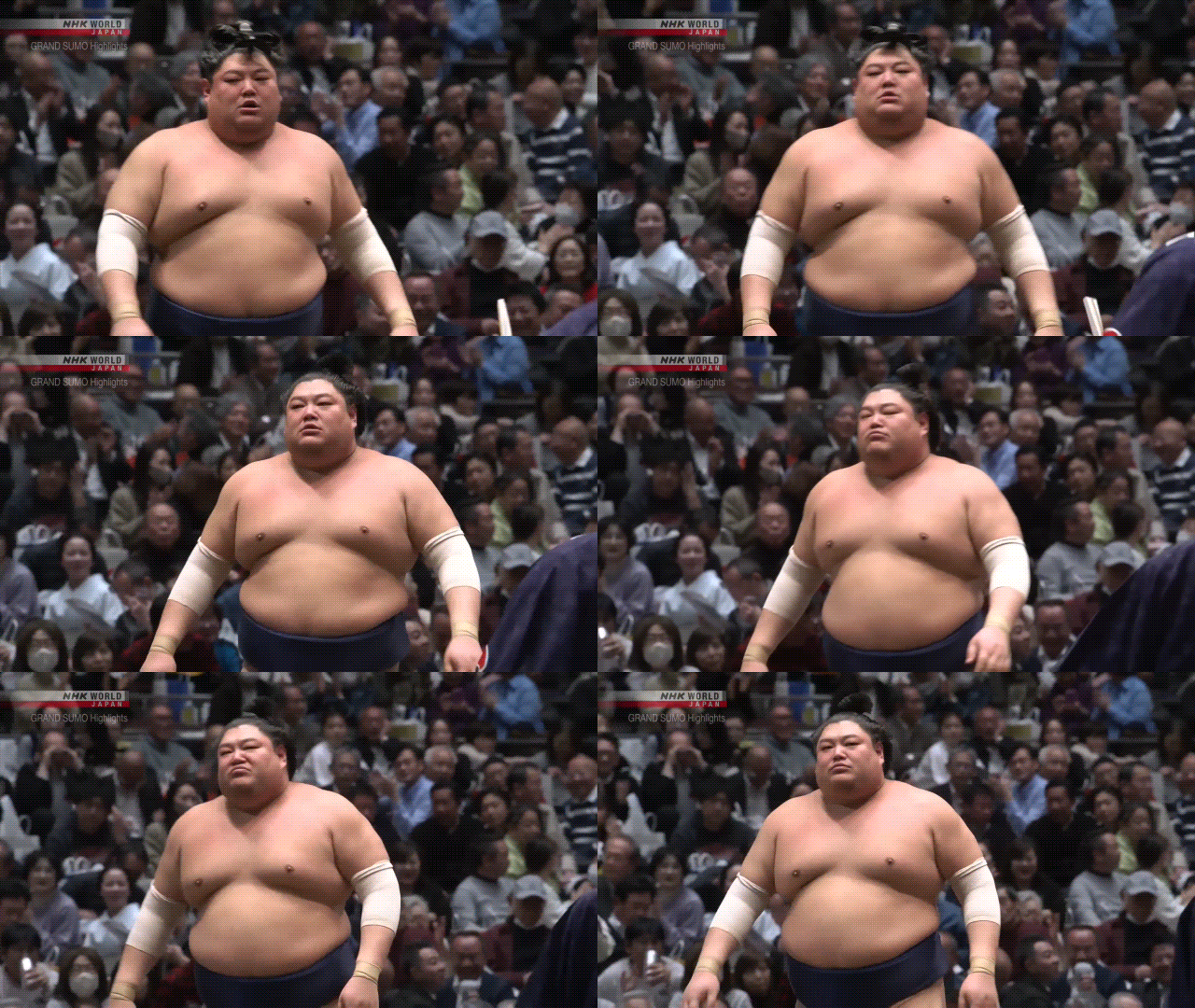
Hatsuyama
Rank: Maegashira 17 West
Record: 2-13
Grade: F
This was Hatsuyama’s first crack at the makuuchi and he didn’t seem cut out for this level, at all. He’s a rangy pusher/thruster, but he just didn’t seem to have the power needed to push back the competition in this division. He was thrown around, with ease, in a lot of his bouts. His hips were often too high, which meant he wasn’t able to use any lower body strength to prevent himself being either slung around or marched backwards. Mr. Big Leaf will be down in the second division in March. Don’t count on seeing him back here anytime soon.
Asahakūryū
Rank: Maegashira 17 East
Record: 8-7
Grade: C+
Asahakūryū was our only other makuuchi debutante at this tournament. Unlike Hatsuyama, he was able to hang in there against his toughest opposition to date. He had a strong start and finish to the basho, but got stuck in the middle — losing five straight between days eight and twelve. Despite this being new territory for the Mongolian, he seemed to fight with a lot of confidence and showed good fundamentals in his yotsu-zumō (belt-grappling). He’s 27, but he’s only been in Grand Sumo since 2022. I think his maturity helped him not get overwhelmed by this assignment. Being part of a stable with other big names (Asanoyama and Asakōryū) also probably helped him prepare for this moment, too.
He was able to keep his makuuchi rank by beating Sadanoumi on the final day. Sadanoumi is a notoriously tough out, especially on the final day when there is something on the line. Asahakūryū won two potential replacement bouts this tournament, against Sadanoumi and Kotoeihō (where losses would have meant he was very likely to be demoted and replaced by the victor). He also beat Shōdai on the penultimate day. That’s a good bit of work for the newcomer.
Oshoumi
Rank: Maegashira 16 West
Record: 10-5
Grade: A-
After some strong jūryō displays, Oshoumi was a tad disappointing in his top division debut in November. He lost eight of his first nine bouts in that basho, giving him a make-koshi before the second week barely began. This time around he looked more confident and even quite menacing on the dohyō. He has great size and a lot of muscle in his arms. That gives him incredible pushing power from inside the clinch (where he likes to do most his work). That also allowed him to rotate opponents with that strong outside arm (like when he hit Ryūden with the utchari).
He’s also just 24 years-old, which is quite hard to believe when you look at him. He out-performed those ranked around him in this tournament in the first week and, in the second week, he was able to get some quality wins over higher ranked opponents (Nishikifuji, Churanoumi and Hiradoumi). On the last day he had an outside shot at getting into a play-off, but a loss to Atamifuji (who was a man on a mission) ruled that out.
It’s early days for Oshoumi, but I’ve seen enough to believe he’s cut out for the top division.
Asanoyama
Rank: Maegashira 16 East
Record: 9-6
Grade: B
Asanoyama did what was expected of him in this tournament. He proved, as a former ōzeki (who only lost his rank due to suspension), that he is too strong and too talented for the bulk of the opponents ranked around him. At times he dominated this lesser opposition. There were a few moments where it seemed his injury history (including a quite recent knee surgery) was holding him back, especially when he suffered an awkward collapse in a loss to Nishikifuji. His title aspirations unraveled down the stretch with him losing to Takayasu and Wakamotoharu on days thirteen and fourteen. He then lost his final bout, to Shōdai, by katasukashi.
He may have lost to his only san’yaku opponents of the tournament, but Asanoyama was able to beat a number of wrestlers in the upper-middle maegashira ranks (Kinbōzan, Hiradoumi, Fujinokawa). I think that means he’s probably going to be OK after the big demotion he gets off this performance.
I’m not sure that his knee will ever be good enough again to get him back to an ōzeki rank. But having Asanoyama around is good for the sport and he’s a great test for the current generation of young jōi and san’yaku candidates.
Asakōryū
Rank: Maegashira 15 West
Record: 9-6
Grade: B-
Asakōryū did something he’s never done before in January; secure a second top division kachi-koshi in a row. This 9-6 follows up from his 8-7 in November. This record was one win off his career best, too, which he earned last May while ranked M17.
It’s a fine record, but I’m still not in love with Asakōryū’s sumō. I think it’s a lot of bark and not much bite. He likes a henka, which is fine. He did a few half henka this tournament, too, where he stepped off to the side to negate the blow coming from the tachiai. That sometimes put him in a bad position (like when he was eventually bundled out by Midorifuji). When he did go forwards, though, he was often up on his toes and thus susceptible to being knocked off his feet. I’d like to see him really sit down on his thrusts and show a bit more confidence and, like I said earlier, bite.
Ryūden
Rank: Maegashira 15 East
Record: 6-9
Grade: D-
I have Ryūden going down to jūryō in March off of this 6-9. That would be his third jūryō demotion since November, 2024. At 35, and with a notable injury history, there’s probably not much gas left in the tank for Ryūden. If he doesn’t pop right up from jūryō this time, he might just call it a day.
He benefited from a hair-pulling disqualification on day one. His other wins came against all opponents who would finish with losing records (including Hatsuyama and Tomokaze). He looked stiff and slow in January and also got his regular katasukashi (under shoulder swing down) loss from Midorifuji (the seventh of his career).
Mitakeumi
Rank: Maegashira 14 West
Record: 7-8
Grade: D+
This was Mitakeumi’s third 7-8 record in a row. It’s enough to keep treading water in the maegashira basement. He’s 33, but looks a lot older than that on the dohyō. That’s likely due to how he carries his weight and the strain that all puts on his mobility.
In this tournament he was able to bully a few smaller guys (Midorifuji, Asahakūryū) and did get around fellow slow vets Ryūden and Shōdai. Mostly, though, he was being out-muscled by younger guys who could match him for bulk. He also scored a henka win over Chiyoshōma.
Shishi
Rank: Maegashira 14 East
Record: 9-6
Grade: B+
Shishi was one of the surprises of the tournament. The other Ukrainian was among the leaders in this tournament. But his title chances fell off, quickly, once he was matched with tougher opponents; he went 1-4 in the last five days.
Over those five days he lost to Abi, Kirishima, Yoshinofuji and Daieishō. The other two losses he took on this tournament were to Asanoyama and Oshoumi, both of whom had great tournaments.
Shishi’s best wins were against Ōhō (his first ever) and the rising Fujinokawa. Shishi’s style looked…
