

Report Card: 2026 Hatsu Basho - Part 3
Continuing to grade the top division rikishi who were involved in the January tournament.
The banzuke for March is out! And that means we don’t have to wait too long until we have some new sumo to talk about. But before that happens, I’ve still got some time to talk about the last sumo we watched — the 2026 hatsu basho.
That was a great tournament and, in this report card, I’ll be talking about the jōi. That’s wrestlers ranked from maegashira 1 to maegashira 4. This section included some stand out performers (Atamifuji and Yoshinofuji) but also some strugglers (Ura and Ichiyamamoto).
Read on to see how I rated them all!
Also, this is a premium post, so if you’d like to read it all you’ll need a paid subscription. Paid subscriptions keep the lights on here. If you like this newsletter/blog, those subscriptions are the best way to make sure it sticks around for the long-term.
Our bonus gif today is the rising Yoshinofuji.
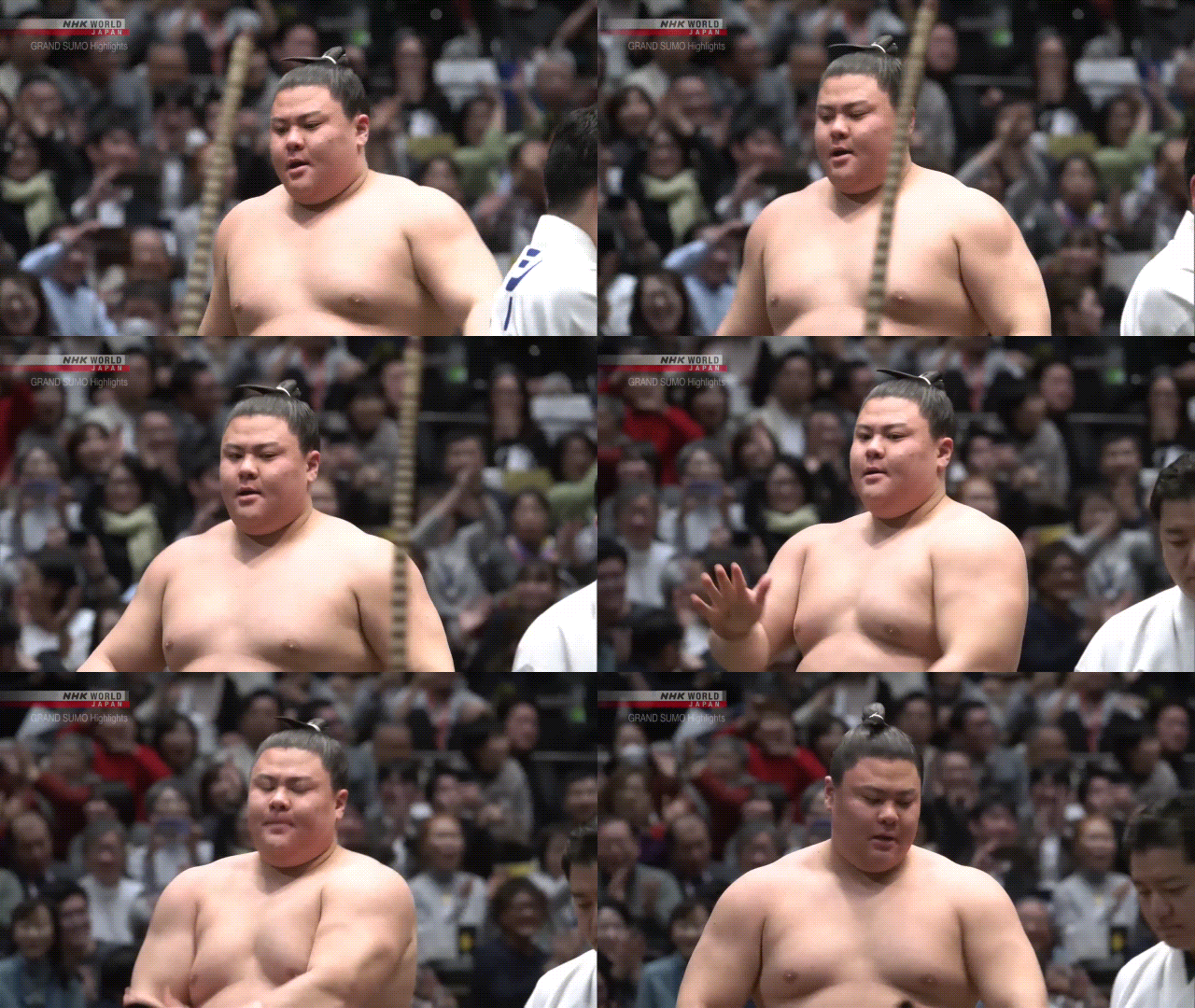
Atamifuji
Rank: Maegashira 4 West
Record: 12-3, doten jun-yushō, kanto-shō, kinboshi (x2)
Grade: A+
I’m so happy for the pudding man!
Atamifuji fell at the final hurdle at the January tournament, losing to Aonishiki in a play-off for the cup. Despite Atamifuji leaving the basho without a title, I think this was an extremely successful tournament for him. And I think there was a tremendous amount of growth on display, both with his sumō and with his character.
The knock on Atamifuji, from a technical standpoint, is that he is too one-dimensional. He has, historically, over relied on yotsu-zumō (belt grappling), with his migi-yotsu (right arm inside position) and gaburi-yori (torso thrusting). From a character standpoint, he’s often appeared too meek and prone to nerves.
In this tournament he was very aggressive with his yotsu-zumō, but was also aggressive with throwing pushes and thrusts. In the past he almost felt too intimidated to mash his palm into an opponent. But that wasn’t true in January. He threw some heavy strikes in this tournament and scored a lot of push out wins. He actually registered four oshidashi (frontal push out) victories in a row in this tournament, followed by an okuridashi (rear push out).
This has been an area of development for Atamifuji that I noticed in the second half of last year. But in January his pushing/thrusting looked especially mean (maybe that’s being influenced by the new Isegahama [former Terunofuji]).
For me, though, the most noticeable positive development for Atamifuji is how confident he looked. When he first established himself in the top division he came close to winning a yushō, twice. In both those tournaments he seemed to be in a flow state early on, but then he crumbled when he realized how close he was to achieving something special. The nerves were visible during those tournaments, with him false starting and taking a long time to get set in crunch matches with eventual winners Kirishima and Takakeishō.
I didn’t see any of that in January, though, even when he was one win away from the yushō. He looked very confident in that Aonishiki play-off bout and he had a great opening charge. He had Aonishiki on his heels, but was just out-foxed by the man who has proven, repeatedly, that he is one of the three best rikishi on the planet. There’s no shame in losing the cup to Aonishiki. I’m just delighted that anxiety didn’t seem to play any kind of role in that outcome.
This indicates a massive step forwards for Atamifuji. And, for me, that turns him from a long standing jōi wrestler to a potential sekiwake and maybe even ōzeki. At just 23 years-old, there’s still a lot of improvement we could see from him.
Daieishō
Rank: Maegashira 4 East
Record: 7-8
Grade: D+
Daieishō was a little unlucky in January. After a terrible start, where he went 1-7, his back was against the wall in the second half of the tournament. He did well to go 6-2 and rescue a respectable losing record. Those two losses, though, were both henka. The first, which confirmed his make-koshi (losing record), came from Ōnokatsu. And the second was from Wakatakakage. His loss to Tamawashi early on was almost a henka, too. If all those bouts were fought straight up, there’s a great chance that Daieishō gets a kachi-koshi (winning record) in January.
I think his sumō deserved a winning record. Daieishō has been famously one-note for the bulk of his career; a pure straight forwards pusher/thruster. However, in this tournament his approach looked more mixed, with him both ploughing forwards in attack, but also being willing to side-step and bait opponents into a pull down.
His recent leg injury has probably encouraged this change. In January he didn’t seem capable of the devastating charges we’re used to seeing from in. I think that’s really helped Daieishō fight smarter, though.
Now that he can’t just rely on his forward charge, he has to be more selective with his bursts forwards and be more cognizant of where and when he can try and trick an opponent. The best trick he pulled this tournament was over Hōshōryū.
He also beat Atamifuji with a side-step on day one. Yoshinofuji, Ōshōma and Ura would all fall victims to surprising backwards/sideward steps from the Battle Pug, too. He almost got Ōnosato, as well.
All that good work didn’t result in a winning record, though, because of those tricksy henka. Thankfully, though, Daieishō’s 7-8 hasn’t been punished by a rank demotion.
Hakunofuji
Rank: Maegashira 3 West
Record: 5-8-2, kinboshi
Grade: D+
Hakunofuji got off to a great start in this tournament. His day one win over Ōhō was a thing of beauty, where he got to show off the incredible power he has in his lower body. Ōhō got Hakunofuji’s heels on the straw, but the former Hakuōhō refused to be moved any further. He was then able to generate enough power to surge forwards, when Ōhō sagged, and land a great throw.
He went 5-3 in the opening week of the basho. And he got a win over Ōnosato (giving him a career record of 3-2 against the yokozuna). His win over Ōnosato does have a slight asterisk, given how hampered Ōnosato appeared in that bout (due to his injured shoulder). However, I want to give Hakunofuji a good amount of credit for that win, since his opening tachiai was pretty epic.
Hakunofuji also forced the best out of Hōshōryū. These two would need a torinaoshi to settle things. In both their bouts things were close, but Hōshōryū’s grappling acumen was able to trump Hakunofuji’s power.
We saw Hakunofuji’s technical grappling get exposed a few other times in this tournament, in his losses to the more experienced Kirishima, Kotozakura, Takayasu and Wakatakakage.
Hakunofuji still has a lot of development ahead of him and I hope he’s able to realize that in his career (I think getting out of Isegahama would help a lot in that respect, especially given the latest news).
Hakunofuji’s January basho was spoiled after he went down to Aonishiki. His left leg folded awkwardly under him in that bout. He would pull out the tournament soon after.
Takanoshō
Rank: Maegashira 3 East
Record: 5-10, kinboshi
Grade: D+
This was Takanoshō’s second 5-10 record in a row, following the 12-3 he earned while ranked M7 in September. This was more proof that Takanoshō struggles when he doesn’t get an opening week against mid-to-low ranked wrestlers. When he does get that smooth entry to a tournament he can be quite formidable in the second week, currying that momentum into wins against elite opponents. In January, though, he didn’t get the luxury of that smooth entry. He lost his first six here.
Takanoshō’s usual modus operandi is to lead with his nodowa (throat thrust) and push that move until he either gets the win or goes down trying. In this tournament he was noticeably more diverse with his sumō, though. Perhaps he felt he needed to mix things up to be competitive against higher ranked foes.
He switched, quite often, from opening approaches with the nodowa and a tachiai with arms down, looking for an inside position. The hands down approach surprised some opponenets. Kotozakura looked like he was expecting the nodowa and, as a result, gave up a moro-zashi (double inside position) to Takanoshō in their bout. Takanoshō was able to out-muscle him from there.
Takanoshō’s best win was over the banged up Ōnosato, though. He went nodowa with him, but reacted really well when Ōnosato was able to brush that off by applying pressure to his outstretched elbow. He showed great footwork in that bout and was able to find an angle for the push out.
In other matches, though, when his nodowa was shrugged off he often span out of position and was then forced down or out.
All in all, this is a bad record on paper, but I appreciated Takanoshō’s efforts. The record is also going to drop him down into a zone where he’s much more comfortable.
Wakatakakage
Rank: Maegashira 2 West
Record: 9-6
Grade: B
This was Wakatakakage’s first kachi-koshi since his 10-5 in Nagoya, which set him up with his best chance ever to claim his long desired ōzeki promotion. He didn’t get that promotion and, in the two tournaments that followed, he looked hung over from that disappointment.
This showing might be evidence of him putting that behind him, though.
