

Report Card: 2026 Natsu Basho
Grading the top division rikishi who were involved in the May tournament.
Hello everyone.
We are about four weeks removed from Wakatakakage scooping his second career yushō and it feels like a great time to send out a report card. In the past I’ve had to file these report cards in multiples and just managed to get them to you before the next tournament starts. I never liked giving them to you so late, even if they did serve as refreshers for the tournament to come.
Personally, I’d much rather write about the tournament closer to when it ended (when things are still relatively fresh in my mind). A big reason why I’m able to do that today is that I’m continuing with my format change from last time — where I put all the grades in one single post and write more succinctly (so the days of four paragraphs on a guy like Nishikifuji are probably over).
I like doing this format because it forces me to focus on the most important things when considering a wrestlers’ entire tournament. This report card will also feature jūryō grades for the first time ever.
At the last tournament, I covered jūryō every day and had that section available for paid subscribers. I’m putting a paywall on this post, right at the end of the makuuchi grades, to let those paid subscribers get bonus jūryō content here, too.
If you’re not a paid subscriber yet, please consider upgrading your subscription. Paid subscriptions make Sumo Stomp! a reality.
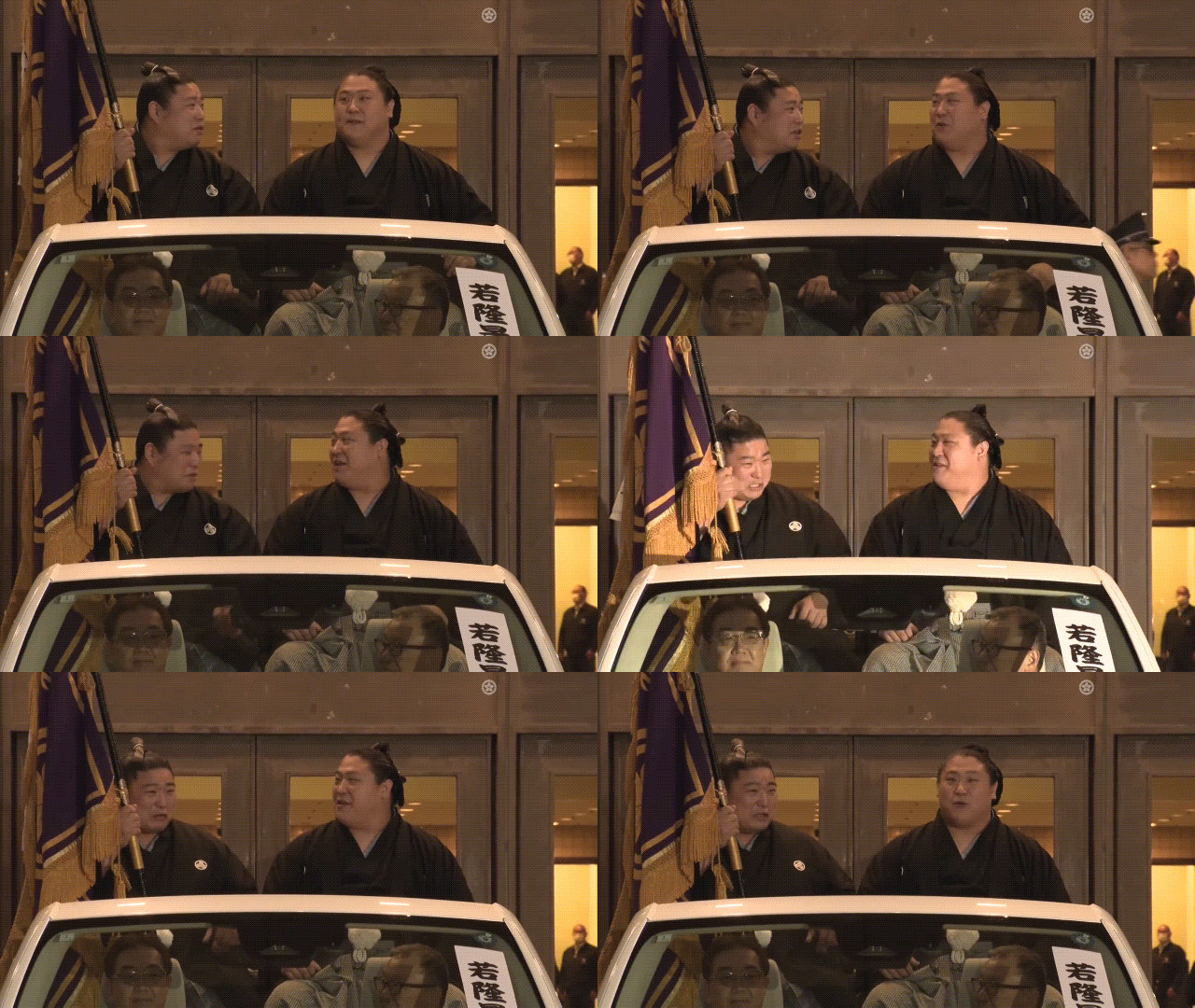
Our bonus gif today is last month’s star boy (and his big bro.).
Wait, one more thing!
Substack is launching a new sponsorship thingy where blogs like mine could get matched with companies who want to sponsor the content. I believe I’m able to have final say on whether I want that sponsor or not. This could potentially provide me with a little boost of revenue. I would only green-light a sponsorship if it was something I thought readers might find interesting (and it wasn’t something I found personally distasteful).
The sponsorship program on here involves making a Creator Kit. I did that. Another part is sending out a survey. The results are then shared with potential sponsors. If you’re interested in helping me out with this, you can find the survey here:
OK, now the grades!
Top of the class!
K1e Wakatakakage (12-3, yushō, gino-shō): A+
O2e Kirishima (12-3, doten-yushō): A
S1w Kotoshōhō (9-6), Hakunofuji (11-4, kantō-shō): A-
Wakatakakage, of course, gets an A+ grade for his title winning performance in May. I’m going to write a spotlight post on him next week, breaking down each of his matches and the overall storyline behind his yushō. So I won’t go into too much detail on him here.
I will say, though, that the most impressive factor — for me — in this yushō was how Wakatakakage locked in after his loss to Kirishima on day eleven. In the last five days of the tournament he was brutally effective and he cleared out all the other pretenders for the cup (Tobizaru, Kotoeihō, Fujiryoga) before getting his revenge on Kirishima.
He showed amazing poise during that run and was so smart about his gameplan for each bout. I’m really looking forward to digging into that with more detail.
Kirishima gets an A from me for falling just short at going back-to-back with championship wins. There were times in this tournament where he looked like the champion in waiting. That’s, in part, thanks to how many big names were missing from the field.
But despite who wasn’t competing, Kirishima still looked like a championship calibre wrestler. His form seemed to flow over, seamlessly, from that March tournament. His sumō looked classy and assured and he used his hatakikomi (slap down) to devastating effect.
He had a stellar opening week (where he went 7-0 against all jōi opponents). And then took his first loss on day eight, to Gōnoyama. Gōnoyama, who was having a strong first half himself, fought a great bout and I think Kirishima might have suffered from a little over confidence; thinking he could win at Gōnoyama’s own pushing/thrusting game.
After this bout he beat Wakamotoharu. I think what happened in that bout had serious implications for the rest of the tournament, though. He had Wakamotoharu on the brink of a force out. But Wakamotoharu then performed his utchari (back pivot throw), which took Kirishima up and over his head and onto the hard ground. Kirishima’s head was bloodied due to that and he appeared pretty woozy.
The day after that he lost to Shōdai, in a bout where he seemed to lose his footing. I don’t know what role the utchari played on Kirishima losing this bout, but it certainly didn’t help.
Kirishima won his next three, including his own utchari on Kotoeihō. Though, his utchari was picture perfect and didn’t involve a slow upright motion that forced an opponent to dive head first to the ground.
Kirishima had a commanding position in the tournament after that Kotoeihō match, but that evaporated after he lost to Hakunofuji on the following day. This was like the Gōnoyama loss in that Hakunofuji was on a hot streak and he gave an incredible single bout performance. Hakunofuji did an amazing job of keeping himself in bounds to prevent a force out (using a hooking leg) and then surprised Kirishima when he used the same leg for a sotogake (outside leg trip) on route to the yoritoashi (frontal crush out).
I don’t fault Kirishima much for losing to Wakatakakage on the final day. Wakatakakage looked like he would have beaten anyone to get this title. At times during the tournament I said that, if Kirishima ended up not winning the yushō it would be considered a huge fumble for him. Now, though, I’m not seeing this as much of a fumble.
Kirishima had an excellent tournament and fell short due to some very good performances (and perhaps that dangerous utchari).
Kotoshōhō and Hakunofuji get A- grades. Both looked excellent at times and still a little raw at others. Still, for Kotoshōhō, to go 9-6 in his debut as sekiwake is very impressive. Hakunofuji was under the radar in the first week, but he went 6-1 in the second week and was mathematically in with a shot of getting into the play-off on the final day.
Hakunofuji earned the ire of the JSA chairman for what he did on the final day; a henka against Fujiseun. I didn’t love the henka, but I understood why he did it in that situation. And I think the criticism he received is more to do with Hakunofuji’s association with the pariah Hakuhō than anything else.
If you’re unable to pick up a paid subscription to Sumo Stomp! but would still like to tip me for these posts, please consider buying me a coffee below (via PayPal).
Best of the rest
S1e Atamifuji (9-6), M2e Yoshinofuji (11-4, kantō-shō): B+
M3w Ōhō (9-6), M11e Ura (10-5), M13e Kotoeihō (10-5), M17e Fujiryoga (10-5): B+
M15e Tobizaru (9-6): B
Like Kotoshōhō, Atamifuji earned a 9-6 record in his debut sekiwake tournament. Whereas that was a big leap forwards for Kotoshōhō, I see this as more of a gradual progression for Atamifuji. Atamifuji has really started to blossom as a high level rikishi lately. He’s had winning records at all three of this year’s tournaments and he is looking very at home in the san’yaku.
At still only 23, there is a lot of exciting potential for the man the fans like to call Atami-pudding. In this tournament, that positive development looked like an increased confidence on the dohyō and more meanness, too. Atamifuji seems sweet like a cherub off the ring. And I think his sweetness translated as meekness in the ring, sometimes, during his early career.
This change in attitude was pretty noticeable on day five in his bout with Fujinokawa. Fujinokawa went early in this bout (we’ll get to that later) and that, I think, is what made Atamifuji turn what could have been a frontal force out into a frontal crush out.
Ura, Kotoeihō, Fujiryoga and Tobizaru were all in the title race this month. That motley crew made for some very fun viewing. Tobizaru fell off the pace first. He got off to a 9-2 start, with those two losses being to Kotoeihō and Fujiryoga. He would go on to lose his last four bouts of the tournament, though. Even so, it was a good tournament for the Flying Monkey, who looked back to his old self during that first week against lesser opposition.
Kotoeihō didn’t drop off until his day thirteen loss to Kirishima. Before that his only other losses were to Ura and Fujiryoga. He looked fantastic in this tournament and seems to have added more upper body strength. He turns 23 just before the Nagoya basho, so he might fill out a little more and get even stronger in the clinch moving forwards (and, in process, really compliment his above average speed).
Fujiryoga was in the title hunt up until his final day loss to Wakatakakage. This was a really great tournament for him. He came out on top in bouts with the pretenders Tobizaru and Kotoeihō and he also managed to score wins over Churanoumi and Yoshinofuji in the final few days. There wasn’t a lot of grace to his sumō in May, but he’s making up for that with a lot of power right now.
He’s also very sturdy when being pushed back, as Yoshinofuji learned.
Fujiryoga’s Achilles’ Heel in June was how unstable he was when being pulled forwards, though — as Hakunofuji learned.
Like Fujiryoga, Ura also had a shot to win the title up until his final day loss to Kirishima (which was a rather brutal beatdown). Ura started this tournament 2-2. That included his first career loss to Nishikifuji (in seven bouts).
But the loses were few after that. And we got our typical grab bag of fun and unexpected moments from the man in pink.
He slingshot Fujinokawa, and then posed for a picture with his hands up in the air. He slung over Fujiryoga (targeting that Achilles’ Heel I just mentioned). He had an amazing reversal on Wakanoshō, where his heels were on the straw. He executed a beautiful last ditch throw on Kotoeihō and he beat Shishi with a perfect head fake to side-step move.
So lots of fun moments from Ura and ten wins, too!
Yoshinofuji gets a very high grade as he cleared a path to the san’yaku for July. He had a slow start (1-3) after losing to Kirishima, Wakatakakage and Kotozakura (a cohort he is 1-8 against — the sole win was over Kirishima over a year ago).
He won nine straight after that, though, before Fujiryoga beat him on day fourteen. He beat Kotoeihō on the last day to give him an outside shot of getting into a play-off. Yoshinofuji’s sumō was excellent for the vast majority of the tournament. He has just turned 24 and, after this latest tournament, I’m pretty comfortable calling him a future ōzeki.
He still looks a little rash and raw at times, but he has amazing athleticism and has great quickness to go along with all that strength. I really like his mentality, too. After those early losses he was able to adjust and go on a deep run that put him into title contention. He looked crushed when he lost to Fujiryoga and I think that’s a really good sign, too. It showed he was confident going into that bout and that he was fighting with a lot of desire.
This is the second time Yoshinofuji has really stood out to me, due to his mental game. The first time that happened was during his debut top division tournament in Kyushu, last year. That’s his home island and we so often see the Kyushu guys struggle in that tournament. They often crumble under the pressure that comes along with that very partisan crowd. Yoshinofuji, a former college star, seems to get energized by that, though. He finished that tournament with a 9-6 record, a technique prize and gold star earned against Ōnosato.
Things like this are a good sign that Yoshinofuji might have what it takes to be a star.
Ōhō gets a high grade for me, too. And it’s because he regrouped after a very tough first week to score an impressive record and show a big improvement over his past few tournaments. This was his first kachi-koshi (winning record) since last September and he got it by winning his last six bouts. It takes a lot of nerve to keep on winning despite being just two losses away form the dreaded make-koshi (losing record).
Want a free way to support Sumo Stomp! Help me get to 1,000 subscribers on YouTube (so then I can monetize the thing).
Doing Enough to Get By
M14w Rōga (9-6), M16e Wakanoshō (9-6): C+
M6e Churanoumi (9-6), M8e Ōshōma (8-7), M4w Gōnoyama (8-7), M6w Fujiseun (7-8), M10e Asanoyama (7-5-3), M14 Mitakeumi (8-7): C-
If I was more cheeky, I might just call this the Rōga category. However, in June the man from Russia did one better than his usual 8-7. This is the third time he’s gotten his career high nine wins in the top division.
Wakanoshō had a great debut tournament and he’s looking a lot like his stablemaster Minatogowa (the former Takakeishō). He really throws himself into those pushing/thrusting battles and I think there might be a spot on the All Violence Team waiting for him in the future.
Churanoumi rebounded nicely in this tournament, having slumped to 4-11 in March (when ranked up at M2). Ōshōma and Gōnoyama did OK, but it was nothing to write home about. That’s a little disappointing from Gōnoyama. This is now his second tournament in a row where he has collapsed in the second week. He was 8-2 before losing his last five bouts.
Fujiseun gets a C- from me despite the losing record. He made a big jump from M13 to M6 in just his second top division tournament. He looked the part of a mid maegashira guy in June and most of his losses came against tough opponents (Asanoyama, Kotoshōhō, Atamifuji, Hakunofuji [by henka]).
Asanoyama’s yotsu-zumō (belt-grappling) looked on point and he was able to successfully mask his battered knees early on. However, he had to bow out the tournament after being forced off the ring by Tobizaru on day eleven. It seems as though he suffered a foot injury, though, and not a potentially devastating reoccurrence of a knee injury.
Mitakeumi continued to tread water at the bottom end of the division. His size and sneaky speed remains tough for a lot of the older and less well-rounded wrestlers to handle. He scored a great win on Hakunofuji on day eight.
Lagging behind
M1w Takanoshō (7-8): D+
M2w Ichiyamamoto (6-9), M3w Hiradoumi (7-8), M7w Asakōryū (3-4-8), Asahakūryū (5-10), Kinbōzan (6-9): D
M1e Fujinokawa (7-8), M4e Daieishō (7-8), M5w Shōdai (6-9), M9w Nishikifuji (5-10), M16w Ryūden (5-10): D-
I’ve been pretty harsh with Fujinokawa here. 7-8 in your debut tournament as M1 is pretty good, on paper. But I just didn’t like his sumō in May. Like so many, I loved Fujinokawa’s truculence as he smashed his way up the rankings to land in the jōi. My enjoyment for his all-out never-say-die style helped me look past a few things I didn’t like; like the early start he used to beat Hōshōryū in March. In this tournament, though, his early starts became hard to ignore.
I think his tendency to do this is starting to rub his opponents the wrong way. Fujinokawa was subjected to a few late pushes and shoves at the end of his bouts, forcing him to the ground or seats despite the match being essentially over. This might be the field trying to correct Fujinokawa (since referees rarely call a matta [false start] nowadays).
Against Kirishima, Fujinokawa’s false start and step-out were missed by the gyoji (and ringside judges).
The early starts are bad enough, but when you sprinkle in the henka, too… Fujinokawa becomes a lot less fun and… kind of annoying. I don’t hate a henka and I think, as a smaller man, he has lots of license to do them. But those, in addition to the early starts, just feel a little too much for me.
His final day henka on Wakamotoharu felt especially pointless, since he had already gotten his make-koshi.
It wasn’t a surprise to see Takanoshō struggle. He rarely gets off to a good start when he’s ranked in the jōi. When he gets a week fighting rank-and-filers he seems to generate momentum which makes him a problem for the upper rankers. In this tournament he actually had a good opening week against the big names, beating Wakatakakage and the debuting sekiwake, while losing to Kirishima and Kotozakura. He struggled against his fellow jōi boys, though, losing to Yoshinofuji, Fujinokawa, Ichiyamamoto and Ōhō.
Ichiyamamoto wasn’t that bad in June. In January he went 4-11 from his career high M1 rank. Going 6-9 at M2 (at his first time at that rank), isn’t anything to be ashamed of. He leaned more into his usual pusher/thruster style in this tournament. A fuss was made about him trying to develop more yotsu abilities lately, but it’s become pretty obvious that — at this point in his career — he’s never going to be good enough or consistent enough at grappling to make a dent against the very skilled grapplers in this section of the rankings.
Hiradoumi was a little disappointing for me. He’s now 26 and starting to look like he doesn’t belong in the group of exciting youngsters who are currently marching up the jōi and into the san’yaku. He might end up being a career whipping boy here in the jōi ranks.
Asakōryū was 2-2 before going down injured against Shōdai. I liked how aggressive he was in those bouts, though.
Asahakūryū faltered after his very impressive 10-5 in March. I was really impressed with his grappling skills in that tournament. In this tournament, though, he looked very robotic and he got schooled by a lot of the veterans he faced.
Kinbozan put in a very forgettable effort after saving his top division skin with a 9-6 from M16 back in March. He’ll have to do that again in July to prevent going back to jūryō for the first time in two years.
Daieishō, Shōdai and Ryūden all looked slow and tired in this tournament. All seem to have their best days firmly behind them now.
Nishikifuji might be the most forgettable man in the makuuchi and he did nothing to change that in this tournament.
Sumo Stomp! is entirely human made. Please continue to support human made writing and art over AI generated content.
Icon by HINOKODO (link).
The Struggle Bus
M7e Chiyoshōma (5-10), M5w Wakamotoharu (5-10): E+
M9e Abi (5-10), M12e Shishi (6-9), M12w Tokihayate (4-11), M13w Tamawashi (2-13): E
M15w Ōshōumi (4-11): E-
O1e Kotozakura (3-9-3): F
Y1e Hōshōryū (0-2-13), Y1w Ōnosato (0-0-15), O1w Aonishiki (0-0-15), K1w Takayasu (2-2-11): Ungraded
There were a few painful watches during this tournament.
It was awful watching Tamawashi labour through an injured calf as he tried, often in vain, to add a few more top division wins to his record chasing haul. He just didn’t have any strength in that leg and and wasn’t able to push off and get any oomph into his normally devastating nodowa (throat thrust).
Wakamotoharu was also difficult to watch. And, unlike with Tamawashi, it wasn’t clear why that was the case. He wasn’t wearing any bandages (which might not mean he wasn’t injured) and he didn’t seem to favour one limb over any other. He just didn’t look like he had much to offer in this tournament. He was pushed around, with ease, often. The younger Kotoshōhō and Atamifuji had zero problems with him.
Kotozakura was also painful to watch at times. I have no idea if he’s still nursing the knee injuries that changed his career projectory from likely yokozuna to barely ōzeki. We’ve seen him hobble through some tournaments. And we’ve seen him look totally refreshed in others. In this one, his body didn’t seem up to the task and his mind seemed totally checked out, at times, too.
There were some good matches sprinkled into his tournament, but more often than not, he was bullied off the ring in a manner we’re not used to seeing.
There was also the incident with Ōhō, where he seemed to drive Ōhō down after the match was over. That might have been his frustration (at his own performance) boiling over. No matter what the motivation as, though, it was a bad look for an ōzeki.
Chiyōshoma was over-ranked in this tournament and also looked a little banged up. Abi doesn’t appear at full strength yet, either. Shishi looked how he usually does; lots of aggression, but zero finesse. I’m very confused by Ōshōumi. He looked great in January, going 10-5, but that is now looking like a flash in the pan. His 4-11 follows the 5-10 he got in March. He’s now jūryō bound.
Tokihayate was the most surprising struggler, to me. I thought he would be good enough for a kachi-koshi at this spot. So to see him get one of the worst records of the tournament was very weird. He also went 5-10 in March. I have really enjoyed Tokihayate’s grappling in the past and I love the smoothness of his throws, particularly his uwatedashinage (pulling over arm throw). He was in a position to pull off those throws, a lot, in May, but he was often finding himself thrown down or being dominated in the clinch. He’s likely going down to jūryō, too, after getting outworked in the clinch by Daiseizan in a probable replacement bout.
